Key Takeaway
A WPC fence is made from wood fiber blended with thermoplastic and additives, engineered to look like wood without the painting or staining a natural wood fence requires. Performance varies significantly by formulation, so capped boards, metal-reinforced posts, and verified warranty terms matter. In California, WPC may require discretionary approval since it is not always listed as a by-right screening material. Request a sample board and test it outdoors before purchasing.
A WPC fence is built from wood-plastic composite boards or panels: wood fiber blended with thermoplastic and performance additives, then engineered into fence infill that looks like wood but doesn’t need the painting and staining a natural wood fence does. That’s the short version. Here’s the part most product pages leave out: WPC is a material category, not one standardized product. Two composite fence panels stamped “WPC” can use different polymers, different additive packages, and different amounts of recycled content, and they can perform very differently in sun, heat, and fire. One can be genuinely durable. The other can look tired in four years.
If you’re a homeowner comparing composite fencing against traditional wood fencing or vinyl for a backyard privacy fence, this guide covers what actually matters: what WPC fence panels are made of, how they’re installed, what to ask before you purchase, and where wood plastic composite makes sense on a Sacramento-region property. We’re a licensed local fence company, and we get asked about composite fencing weekly.
What Is a WPC Fence, and What Does WPC Stand For?
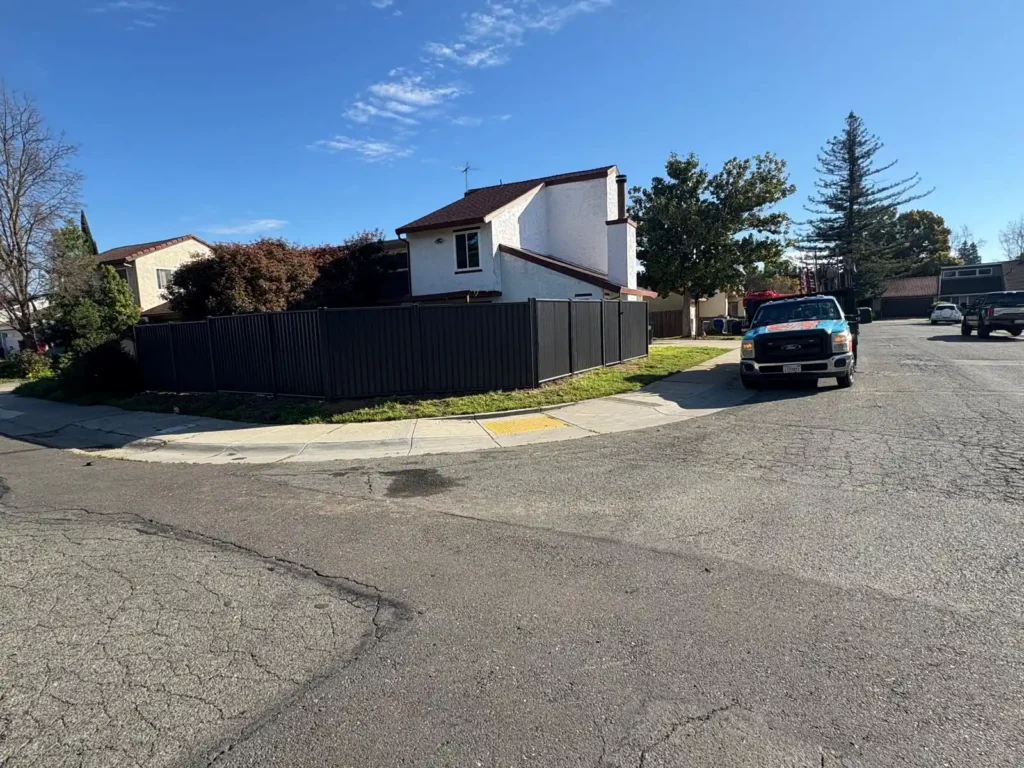
WPC stands for wood-plastic composite. The same acronym gets used for flooring and interior wall panels, which is part of why search results for the term are such a mess. In fencing, it refers to composite boards or fence panels used as privacy fence infill, gates, garden screening, and screening on light commercial projects. “Composite fence” and “WPC fence” are used interchangeably in the market, and so are “composite fence panels” and “WPC fence panels.”
What the letters do not tell you:
- How much wood is in the board, or what kind of plastic binds it
- Whether the surface is capped with a protective polymer shell
- Whether the posts and rails carry internal metal reinforcement
- What the warranty covers, excludes, or how long replacement panels stay available
Judge the product documentation, not the acronym.
What Are WPC Fence Panels Made From?
Most composite fence boards combine four things:
- Wood flour or short wood fiber, often from reclaimed or recovered wood
- Thermoplastic, usually polyethylene, polypropylene, or PVC, sometimes with recycled content
- Additives: pigments, coupling agents, UV stabilizers that slow damage from UV rays, and biocides
- An optional cap layer, co-extruded over the core
Research from the USDA Forest Products Laboratory notes that extruded WPC products commonly contain roughly 50% to 60% wood. Treat that as a general technical reference, not a specification for any fence you’re shopping. Wood content, polymer type, additive quality, density, and profile construction all vary from manufacturer to manufacturer.
That variability is the whole reason two composite fence panels can look identical on a showroom floor and age completely differently after five Sacramento Valley summers. It’s also why a single sample board tells you more than a brochure ever will.
Not All Composite Fencing Is the Same: Capped vs. Uncapped, Hollow vs. Solid
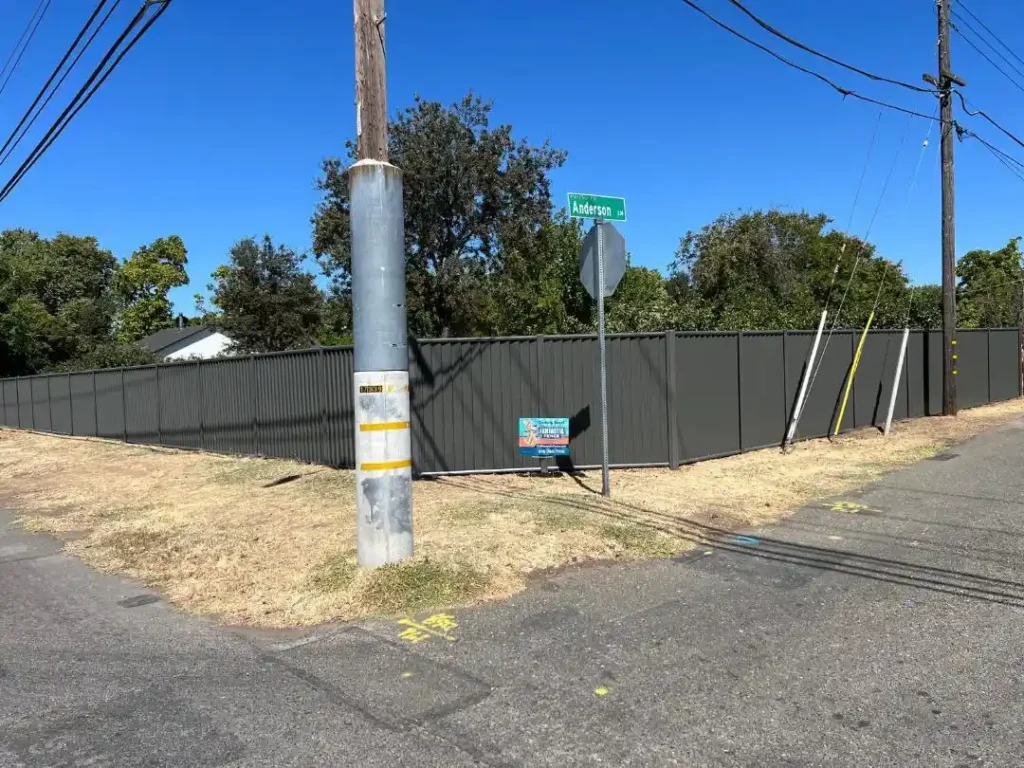
Capped vs. uncapped. Capped boards have a polymer shell extruded over the composite core. USDA research found that a hydrophobic cap layer reduced discoloration during accelerated UV exposure. That’s meaningful, but it isn’t a blanket win. Performance still depends on cap integrity and on the formulation underneath, and a cut or gouged cap exposes the core.
Hollow vs. solid. Hollow profiles weigh less and cost less to ship. Solid boards generally feel more substantial and are more impact resistant. Ask for the wall thickness, not just the outside dimensions.
Board orientation. Horizontal and vertical layouts change the look, the rail structure needed, and (as you’ll see below) fire behavior. Some systems allow customized layouts that mix horizontal infill with taller privacy sections.
Post and rail construction. Some WPC fence systems use aluminum or steel reinforcement inside composite posts and rails. Others are composite only. That single difference drives most of the structural integrity and most of the long term durability.
Compare complete systems, including posts, rails, brackets, fasteners, and gate accessories. Comparing face boards alone tells you almost nothing.
What Are the Advantages of WPC Fencing?
There’s a real case for composite fencing, and it’s mostly about upkeep and appearance:
- Wood-like grain and color that keeps the beauty of a wood fence, without an annual painting or staining routine
- More resistant to rot, fungal decay, and insect damage than untreated wood
- Minimal maintenance beyond a periodic rinse and an occasional wash
- No splintering, which matters around kids, dogs, and pool decks
- Consistent factory profiles, crafted to a uniform width, thickness, and color
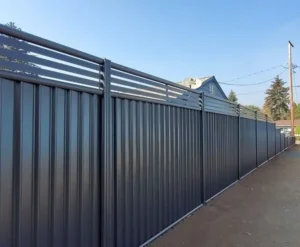
- Modern horizontal styles that suit contemporary patios, gardens, and backyard outdoor space
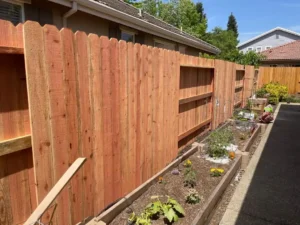
- Useful for short garden screens and planter surrounds, not just full-height boundary fence runs
- Workable for both residential yards and light commercial applications
One honest caution before you go further: “low maintenance” is accurate. “Maintenance-free” is not, and any supplier who uses that word is selling you something they can’t back up.
What Are the Disadvantages of a WPC Fence?
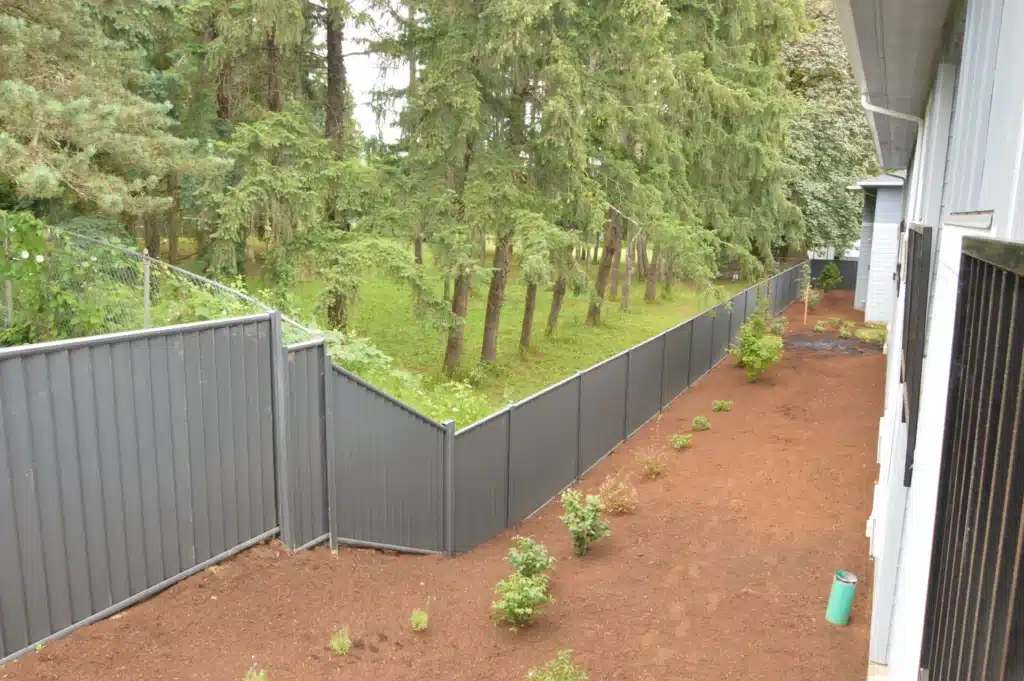
The trade-offs are just as real:
- Higher upfront purchase than most wood fencing. Run your own numbers with our Fence Price Calculator or ask for a free fence estimate.
- Thermal movement. The plastic portion expands and contracts with temperature, which matters in Sacramento Valley heat and can lead to buckling or warping if the installation doesn’t allow for it.
- Color change and surface weathering over time, especially on dark colors in full sun.
- Mold, mildew, and staining are still possible on the surface.
- Weight and installation precision. WPC fence panels are heavy, and the system is less forgiving of field improvisation than wood.
- Repair usually means replacement. A damaged board typically gets swapped out rather than patched.
- Discontinued colors and profiles. Sourcing a matching board five years after installation isn’t guaranteed.
- Fire behavior is product-specific, which deserves its own section.
Durability: Does WPC Fencing Rot, Fade, or Warp?
It resists those things better than untreated wood. It is not immune to them, and the research on WPC durability is clear on this.
A 2024 USDA Forest Products Laboratory report summarizing roughly 20 years of research found that moisture-driven swelling of the wood particles can create microcracks in the plastic matrix, eventually allowing decay fungi to reach the wood component. A separate 17-year field-exposure study found that UV stabilizers slowed color change and fungicide additives provided some decay protection, but mold and staining still occurred, and results varied by formulation and by test location.
Lower-grade formulations tend to show it first: surface wear along the boards, fading on the sun-facing side, and material that turns brittle enough to show cracking around fastener points.
So when you see “rot-proof” or “never fades” in a listing for composite fencing, read it as marketing, not as a performance guarantee.
Practically, that means: keep the panels out of standing water and direct sprinkler spray, maintain drainage along the fence line, avoid burying board ends in soil or mulch, and expect some color settling in the first couple of years. Those habits do more for real-world durability under local weather conditions than any advertised number.
Is WPC Fencing Fire-Resistant?
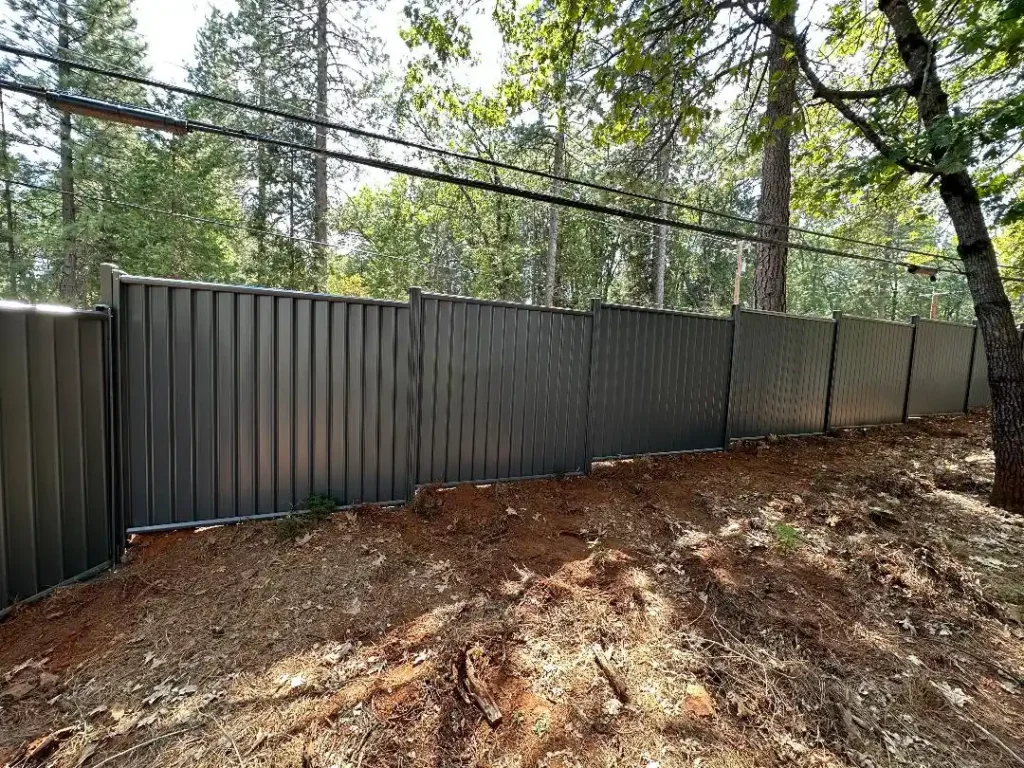
Don’t assume it is. In November 2025, NIST published full-scale research on wind-driven fire spread along composite fences. Researchers tested two WPC fences and one steel-plastic composite fence at a nominal wind speed of 6 meters per second (13 mph), with a target structure 1.83 meters (6 feet) downwind. Two of the three systems showed severe fire behavior. The one WPC design that behaved less severely did so because its horizontal board configuration let boards drop as they burned, keeping flames lower.
Design and orientation changed the outcome, not the material label. NIST used ASTM E1354 cone-calorimeter procedures as part of the work (current edition ASTM E1354-26), and ASTM states plainly that this bench test alone does not account for every factor in real-world fire risk.
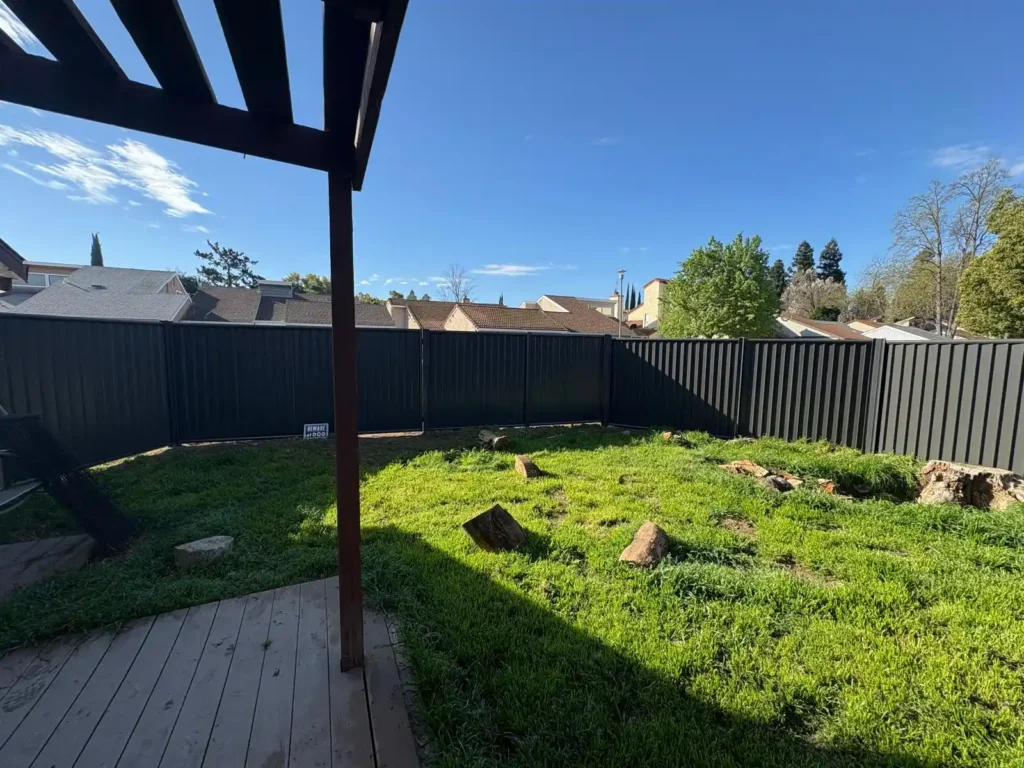
CAL FIRE’s home-hardening guidance recommends replacing the first 8 feet of an attached combustible fence or gate with a noncombustible option, and keeping a parallel combustible fence at least 10 feet from the home. If your fence ties into the house, ornamental iron and Durabond steel are noncombustible alternatives worth considering for that connection.
Ask any supplier for product-specific fire test documentation. The material name is not evidence.
WPC Fence vs. Wood, Vinyl, and Steel: How Do They Compare?
There’s no universal winner here. The right material depends on whether you care most about appearance, upkeep, long-term repairability, or fire exposure near a structure. Here’s how the four common options stack up.
| Factor | WPC composite | Wood | Vinyl | Ornamental iron / Durabond steel |
|---|---|---|---|---|
| Appearance | Wood-like grain, more organic texture than vinyl | Natural, stainable, ages visibly | Clean and uniform, less realistic grain | Elegant and open, or sleek and solid |
| Privacy | Full privacy fence panels available | Full privacy, including good neighbor fence layouts | Full privacy | Iron is open; steel can be solid |
| Painting or staining | No staining required for most products | Periodic staining or sealing recommended | Not required | Occasional finish touch-up on iron |
| Repair and parts | Board or panel replacement; colors can be discontinued | Easy board-by-board repair with common lumber | Panel or picket replacement; profile-specific | Section repair or re-welding |
| Heat movement | Expands and contracts; needs manufacturer-specified allowances | Minimal thermal movement; moves with moisture | Expands and contracts | Minimal for practical purposes |
| Fire near a structure | Combustible; behavior varies by product and design | Combustible | Combustible | Noncombustible |
| Customization | Limited to the system’s heights and colors | Highly customizable on site | Moderate | High, including automated gates |
| Local installer familiarity | Varies by product | Widely installed | Widely installed | Widely installed |
We install wood, vinyl, ornamental iron, Durabond steel, chain link, and Bolt-Up Hidden Steel Posts, and we’ll tell you honestly where each one fits.
What Elk Grove and California Homeowners Should Check First
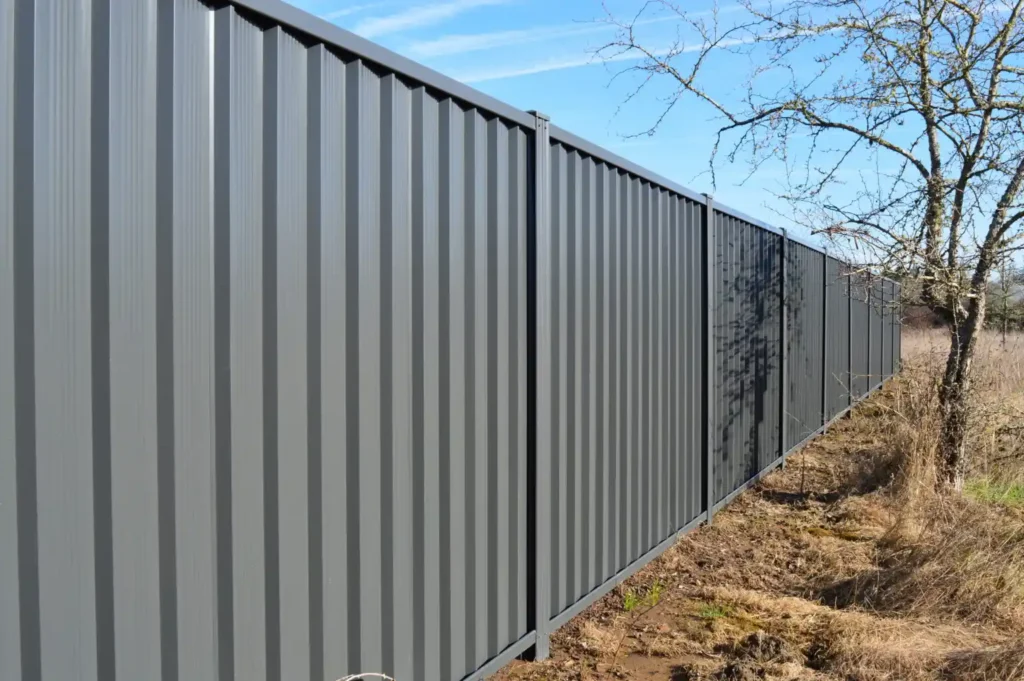
Before you order panels, confirm the local rules. A few things Sacramento-region homeowners should verify:
- The 2025 California Building Standards Code took effect January 1, 2026.
- Elk Grove’s general fence height thresholds: 3 feet in the required front yard; 3 feet in a required street-side yard when the fence is less than 5 feet from the back of sidewalk, or 7 feet when it’s at least 5 feet back; 7 feet in required interior side and rear yards, up to 8 feet there with a City building permit; 10 feet outside required yards.
- Elk Grove’s by-right residential screening material list names solid wood, solid vinyl, masonry, tubular steel, and wrought iron. WPC is not expressly listed. Alternative materials may require discretionary approval, so check with the City before you purchase panels.
- HOA and CC&R architectural approval still applies, permit or not.
- Pool safety fence projects fall under California Health & Safety Code Section 115922 and should be confirmed against current local ordinance.
- Call USA North 811 at least two working days before digging post holes. A standard California ticket stays active 28 calendar days.
Ordinances change. Verify the current rules before you order anything, and use our Fence Ordinance Quick Links as a starting point.
How WPC Fence Panels Are Installed
Composite fencing is a system, and the posts carry it. On most WPC fence installations, the posts are set in concrete footings in firm ground at the manufacturer’s approved spacing, then rails or brackets fasten to the posts, and the composite fence panels or individual boards seat into channels between them. Get the post layout wrong and nothing downstream fits, because factory panels don’t tolerate field trimming the way cedar does. Mark the run with stakes and a string line first.
Three details separate a clean installation from a callback:
- Expansion allowances. Boards have to be installed with the specified gap at the ends so summer heat has somewhere to go. Tight-packed panels buckle.
- Gate framing. Composite alone usually isn’t enough for a gate leaf. Reinforced or metal-framed gate posts add the stability the hardware needs, and corners take the same kind of stress, so plan both before you dig.
- Grade changes. Rigid panels typically step down a slope rather than rake with it, so the layout has to be planned before the first post hole is dug.
Use corrosion resistant fasteners, follow the written manual instead of a generic spacing number found online, and keep the bottom of the panels clear of soil and irrigation heads. Whoever installs it should be licensed, bonded, and insured.
Where to Purchase WPC Fence Panels, and Why a Sample Matters
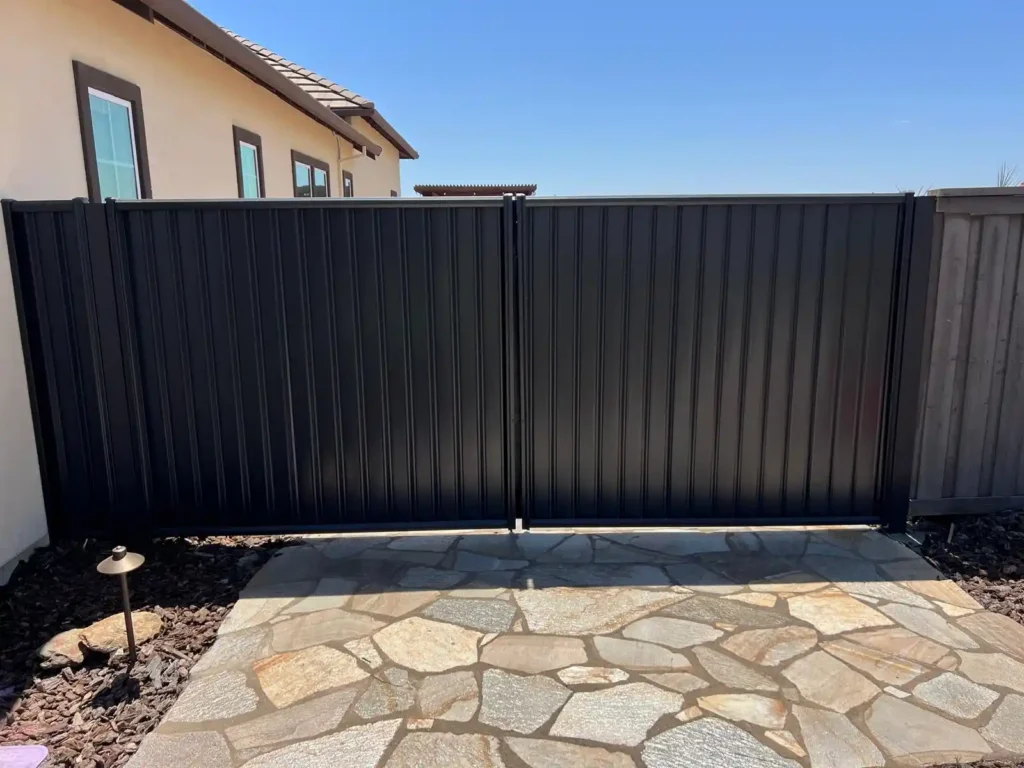
You’ll find composite fencing through specialty fence distributors, big-box home improvement retailers, and direct online sellers. The selection, documentation, and parts support vary a lot between those three, and online-only sellers are where replacement-board availability tends to disappear first.
Whatever route you take, get a sample board in your hands before you purchase anything. Then actually test it:
- Leave one sample outside in full afternoon sun for several weeks and keep a second sample indoors as a control, then compare color
- Set a sample on hot concrete at midday and touch it, since dark composite gets hot
- Wet a sample, let it dry, and look for swelling, chalking, or raised fiber
- Try to scratch the cap layer, because that’s what a weed trimmer will do
- Ask whether the sample represents current production, not a discontinued run
A sample costs you a few weeks of patience and saves you from a fence you’ll resent.
WPC Fence Maintenance: What Low Maintenance Actually Means
Rinse the boards and wash them gently with the manufacturer’s approved cleaner. Address mold and mildew early rather than letting it set, and clean up grease splatter from a nearby grill before it soaks into the surface. Keep dirt, mulch, and irrigation spray off the panels, inspect brackets and fasteners seasonally, and watch for movement at joints where boards meet posts. There’s no universal cleaning schedule, and using the wrong cleaner can void a warranty, so follow the stated care requirements for your exact product.
On sustainability: some wood plastic composite products do incorporate reclaimed wood fiber and recycled plastic, but recycled content varies widely. A material that’s technically reprocessable may not be accepted by your municipal recycling program, and the EPA advises checking locally. Ask for a recycled-content declaration or a documented end-of-life pathway.
Frequently Asked Questions
Is WPC fencing expensive?
Generally a higher upfront purchase than most wood fencing, and comparable to or above vinyl, with lower ongoing painting and staining costs over the life of the fence. Costs move with height, gates, terrain, and demolition of an old fence. Use our Fence Price Calculator or request a free fence estimate for real numbers on your property.
What are the pros and cons of WPC fences?
Pros: wood-like appearance, no routine painting or staining, no splintering, more rot resistant than untreated wood, and uniform factory panels. Cons: higher upfront purchase, thermal movement, gradual color change, possible surface mold, board-level replacement instead of repair, and fire behavior that varies by product.
How long does a WPC fence last?
Manufacturers commonly advertise 30 to 50 years of durability. Treat that as a marketing claim, not a guarantee. Actual service life depends on the formulation, whether the board is capped, sun and irrigation exposure, installation quality, and what the written warranty genuinely covers and excludes.
Can WPC fence panels be used for gardens and patios?
Yes. Shorter composite fence panels work well as garden screens, planter borders, and patio privacy walls, and they’re a common choice where a smooth, splinter-free surface sits close to seating. Even on a small run, the posts still need proper footings.
Does Home Depot sell WPC fencing?
Major home improvement retailers do stock composite fence panels and kits, usually in a limited selection of colors and heights. Seeing a sample in person is useful. Just remember that a big-box panel still needs correct posts, footings, gates, and local approval, and stocked profiles and configurations can change from one year to the next.
Not Sure Which Fence Material Is Right for Your Property? Let’s Talk.
Most people comparing fence materials online are doing it because contractors have let them down before, or because this is a large purchase and they want to get it right the first time. Fair enough. We’re licensed, bonded, and insured (CSLB License #979657), our crews are background-checked W-2 employees, and we quote flat pricing with zero hidden fees. Our written guarantee says the job isn’t finished until you give the thumbs up, and we clean up thoroughly because we’re guests on your property. Financing is available for Sacramento-region residents.
We have three offices, in Rocklin, Sacramento, and Elk Grove at 9245 Laguna Springs Dr, Suite #228, and we serve Sacramento, Placer, El Dorado, Yuba, Yolo, and Nevada counties. Call your local office or Book Online for a free fence estimate, and we’ll walk you through wood, vinyl, ornamental iron, Durabond steel, and chain link, and tell you honestly which one fits your property.