
Tennis Court Fence Installation & Repair in Sacramento, CA
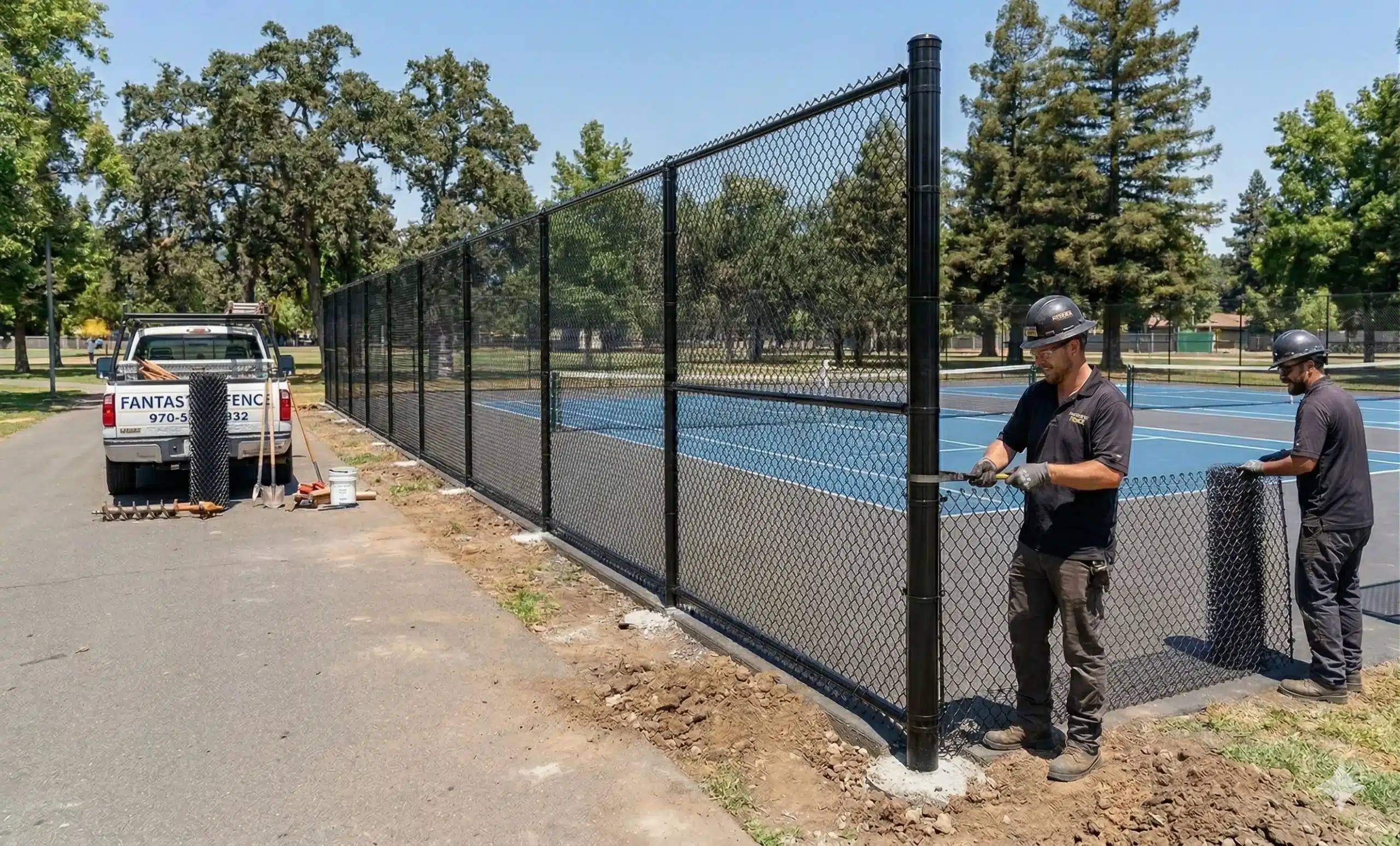
Whether you manage a private tennis club, a homeowners association, a public park, or a school district, Fantastic Fence is the Sacramento region’s experienced choice for tennis court chain link fence installation and repair. We have installed and repaired tennis court fences across Sacramento, Placer, and EI Dorado counties for residential estates, community parks, apartment complexes, and athletic facilities.
Tennis court fencing is a specialty application of chain link fencing that requires specific materials and expertise that set it apart from a standard chain link fence. The mesh size is smaller, the fence is taller, and the framework needs to be heavier to handle the height and daily ball impact. Our experienced installation crews understand these requirements and build tennis court fences that perform for years with minimal maintenance.
"*" indicates required fields
What Makes a Tennis Court Fence Different From a Standard Chain Link Fence?
If you have ever looked at a tennis court fence and a regular chain link fence side by side, you may have noticed they look a little different. That is because tennis court fencing is built to a different set of specifications designed specifically for the game oftennis.
Smaller mesh openings
A standard residential or commercial chain link fence typically has a 2-inch or 2 1/4-inch diamond mesh opening. Tennis court chain link uses a tighter 1 3/4-inch mesh. This smaller opening is specifically designed to prevent tennis balls from getting wedged into the fence during play. Anyone who has played tennis near a standard chain link fence knows the frustration of balls getting stuck the smaller tennis mesh eliminates this problem.
Taller height
Most tennis court fences are 10 feet tall, which is significantly taller than the typical 4-foot to 6-foot residential fence. This height is necessary because tennis balls can travel at high speeds and reach impressive heights, especially during serves and overhead shots. We have installed tennis court fences ranging from 8 feet to 10 feet depending on the specific needs ofthe court and its surroundings. Eight-foot fences are sometimes used on clay or Har-Tru courts where the ball does not bounce as high, or along the sides of a court where lower fencing allows for better spectator viewing
Top and bottom rail
On a standard chain link fence you will typically see just a top rail. Tennis court fences include both a top rail and a bottom rail. The bottom rail serves an important purpose - it creates a solid edge along the ground that prevents tennis balls from sneaking out underneath the fence. Without a bottom rail, balls would constantly roll under the fence during play, disrupting games and causing players to lose balls. This is a detail that makes a real difference in the day-to-day use of a tennis court.
Heavier gauge framework
Because tennis court fences are taller and take more impact from balls and wind, the posts and rails need to be heavier duty. The industry standard for tennis court fencing is Schedule 40 powder-coated framework, with 3-inch terminal (end and corner) posts and 2 1/2-inch line posts. Some contractors cut corners by using smaller posts throughout, but this leads to a fence that flexes too much and does not hold up over time.
Vinyl-Coated (Bonded) Chain Link - The Most Popular Choice
The most common choice for tennis court fencing is vinyl-bonded coated chain link in either black or green. The vinyl coating is fused to the galvanized steel wire, which provides two layers of protection against rust and corrosion. Black is by far the most popular color because it blends into the background and gives the court a clean, professional appearance. Green is the second most common choice and works especially well in park settings where the fence blends with surrounding landscaping. The vinyl coating also provides a smoother finish on the wire, which means fewer snags on clothing and less chance of scrapes if a player runs into the fence during an aggressive point.
Galvanized (Silver) Chain Link - The Budget-Friendly Option
For tennis court projects where budget is the primary concern, we also install standard galvanized (silver) chain link fencing. Galvanized fencing is the same steel wire dipped in a zinc coating to protect against rust, but without the additional vinyl color coating. lt is a perfectly functional and durable option – it simply does not have the same finished aesthetic appearance as the vinyl-coated option. Galvanized tennis court fencing costs less per linear foot and is a popular choice for school districts, municipal parks, and facilities where the priority is function over appearance.
Tennis Court Fence Material Options

Tennis Court Fence Specifications at a Glance
| Feature | Tennis Court Fence | Standard Chain Link |
|---|---|---|
| Mesh Size | 1 3/4 inch | 2 inch or 2 1/4 inch |
| Height | 8 to 10 feet (10 ft most common) | 4 to 6 feet |
| Wire Gauge | 9 gauge (commercial grade) | 9 or 11 gauge |
| Top Rail | Yes — 1 5/8 inch | Yes — 1 5/8 inch |
| Bottom Rail | Yes — prevents ball escape | Typically no |
| Color Options | Black, green, or galvanized | Black, brown, green, or galvanized |
| Terminal Posts | 3 inch Schedule 40 | 2 3/8 inch |
| Line Posts | 2 1/2 inch Schedule 40 | 1 7/8 inch |
Tennis Court Fence Layout and Design Considerations
When we come out to your property for a free estimate, our team will work with you on the layout and design of your tennis court fencing. Here are some of the factors we consider:
Full perimeter vs. partial fencing
A standard single tennis court requires a fenced area ofapproximately 60 feet wide by 120 feet long. Many courts use 10-foot fencing along the baselines (the ends) and returning approximately 20 to 30 feet along each side. After that, the side fencing can step down to 3 or4 feet to allow for spectator viewing, or it can remain at 10 feet for full ball containment.
Gate placement and sizing
Every tennis court needs at least one gate for player access, and we recommend including a wider gate for maintenance equipment. Gates should be placed at a location that does not interfere with play - usually at a corner or along the side ofthe court.
Windscreens
If your court is in an area that gets a lot of wind, adding vinyl windscreens to the chain link can significantly improve the playing experience. Windscreens reduce wind interference, provide shade, and add privacy. They are made of heavy-duty mesh material with reinforced binding and grommets, and they come in a variety of colors including black, green, blue, and white. Windscreens also look great with your club or facility logo printed on them.
Privacy slats
While most tennis court fences do not include privacy slats, some facilities request them for courts that sit close to roads, parking lots, or neighboring properties. Privacy slats can also help reduce distractions for players during competitive matches.
Tennis Court Fence Repair

Is your existing tennis court fence showing its age? Over time, tennis court fences can develop issues that affect both the appearance and function of your court. Common tennis court fence repairs we handle include:
- Sagging or stretched mesh. Years of ball impact and weather can cause the chain link mesh to stretch and sag, leaving gaps at the bottom where balls escape. We can re-tension the existing mesh or replace sections that are beyond repair.
- Bent or leaning posts. High winds, ground shifting, or impact damage can cause fence posts to lean or bend. We replace damaged posts and reset them in fresh concrete footings.
- Damaged top or bottom rails. Rails can become dented, disconnected, or rusted over time. We replace damaged rail sections and ensure all connections are secure.
- Rust and corrosion. Even galvanized and vinyl-coated fences can develop rust over many years, particularly at connection points and where the coating has been worn away. We replace corroded sections and restore the fence.
- Gate repairs. Tennis court gates take a lot of use. Hinges wear out, latches break, and gates can sag.
We repair and replace gate hardware, adjust alignment, and install new gates when needed.
If your tennis court fence needs repair, we will come out for a free inspection, assess the condition, and let you know whether a targeted repair orfull replacement makes the most sense for your situation.
Who We Build Tennis Court Fences For
- Homeowners with private backyard tennis courts
- Homeowner associations (HOAs) with community tennis court amenities
- Apartment complexes and planned communities
- School districts building or renovating athletic facilities
- City and county parks departments maintaining public tennis courts
- Private tennis clubs and athletic facilities
- Churches and community organizations with recreational courts
No matter the size of your project, from a single residential court to a multi-court complex, our experienced crew has the skills and equipment to get the job done right.

Why Sacramento Property Owners Choose Fantastic Fence
We know the specialty materials
Tennis court fencing is not something every fence company handles regularly. We stock and source the proper 1 3/4-inch tennis mesh, Schedule 40 framework, and bottom rails that are required for a correct installation.
Licensed, bonded, and insured
Fantastic Fence holds California State Contractor License #979657. We carry full insurance and bonding, which is especially important for commercial and municipal projects.
We serve six counties
With offices in Sacramento, Placer, and El Dorado counties, we serve the entire greater Sacramento region including Roseville, Rocklin, Folsom, EI Dorado Hills, Citrus Heights, Rancho Cordova, Elk Grove, Woodland, West Sacramento, Yuba City, and Marysville.
Free on-site estimates
We will come to your property, assess the layout, discuss your needs, and provide a detailed written estimate at no cost and no obligation.
FREQUENTLY ASKED QUESTIONS ABOUT TENNIS COURT FENCES
How tall should a tennis court fence be?
The standard height for a tennis court fence is 10 feet. This is tall enough to contain the vast majority of shots during play, Some courts use 8-foot fencing, typically on clay court surfaces where balls do not bounce as high, or along the sides of the court where shorter fencing improves spectator views. We recommend 10-foot fencing at minimum along the baselines (ends of the court) where most high shots occur.
Why is the mesh on a tennis court fence smaller than a regular chain link fence?
Tennis court fencing uses a 1 3/4-inch mesh opening compared to the standard 2-inch or 2 1/4-inch opening on regular chain link. This smaller opening prevents tennis balls (which are approximately 2.7 inches in diameter) from getting wedged into the fence. With standard mesh, the balls can partially push through and
get stuck, which disrupts play and can damage the fence over time.
What color tennis court fence is most popular?
Black vinyl-coated chain link is by far the most popular choice for tennis court fencing. Black fencing visually recedes into the background, giving the court a cleaner look and providing better contrast for players tracking the ball. Green is the second most common choice. Galvanized silver is available as a more budget-friendly option.
Does a tennis court fence need a bottom rail?
Yes. A bottom rail is standard on tennis court fences and we strongly recommend including one on every installation. The bottom rail prevents tennis balls from rolling or bouncing underneath the fence. It also adds structural rigidity to the bottom ofthe fence and creates a cleaner finished appearance.
How much does a tennis court fence cost?
The cost of a tennis court fence depends on several factors including the total linear footage, height, material choice (vinyl-coated vs. galvanized), gate requirements, and site conditions. Because every project is different, the best way to get an accurate estimate is to schedule a free on-site consultation. We will measure your court, discuss your options, and provide a detailed written quote.
Do you repair existing tennis court fences or only install new ones?
We do both. Our crew handles everything from minor repairs like fixing sagging mesh and replacing damaged posts, to full tear-out and replacement of aging tennis court fences. We will assess your existing fence and recommend the most cost-effective solution.
What areas do you serve for tennis court fence installation?
Fantastic Fence serves six counties across the greater Sacramento region, including Sacramento County, Placer County, EI Dorado County, Yolo County, Sutter County, and Yuba County. Our service area includes Sacramento, Roseville, Rocklin, Folsom, EI Dorado Hills, Citrus Heights, Fair Oaks, Orangevale, Rancho Cordova, Elk Grove, Woodland, West Sacramento, Davis, Lincoln, Auburn, Yuba City, and Marysville.
Ready to Get Started on Your Tennis Court Fence Project?
Whether you are building a new tennis court, replacing aging fencing, or need repairs on an existing court, Fantastic Fence is ready to help. Contact us today to schedule your free on-site estimate.
Call us today or schedule online at callfantasticfence.com




