What Sacramento-area homeowners need to know before building a shared boundary fence
It’s one of the most common questions we hear from homeowners across Roseville, Rocklin,
Lincoln, Citrus Heights, and Folsom: “Can I build myfence directly on the property line?” The short
answer is yes-absolutely-as long as both neighbors are in agreement. But there’s more to it than
just picking a spot and starting to dig. California has specific laws governing shared boundary
fences, and understanding those rules before you start a project can save you time, money, and a
whole lot ofheadaches with the people living next door.
Yes, You Can Build a Fence on the Property Line

Lets get straight to the point: building a fence directly on the property line between two homes is perfectly
legal in California and is actually quite common. In fact, when a fence sits on the boundary between two
properties, California law considers it a shared structure that benefits both homeowners equally. This is
the standard arrangement for most residential fences in subdivisions throughout Roseville, Rocklin, and
the greater Sacramento area.
The key requirement is that both neighbors need to be on the same page. When both property owners
agree on the fence’s placement, style, and scope, the process is smooth and straightforward. Problems
only tend to arise when one neighbor moves forward without communicating with the other-and thats
exactly what California law is designed to prevent.
How Fantastic Fence Handles Property Line Fence
At Fantastic Fence, we’ve made it a standard policy to reach out to both neighbors whenever a fence is
going on or near a shared property line. This isntjust a courtesy-its the right way to do business, and it
makes for a better project from start to finish.
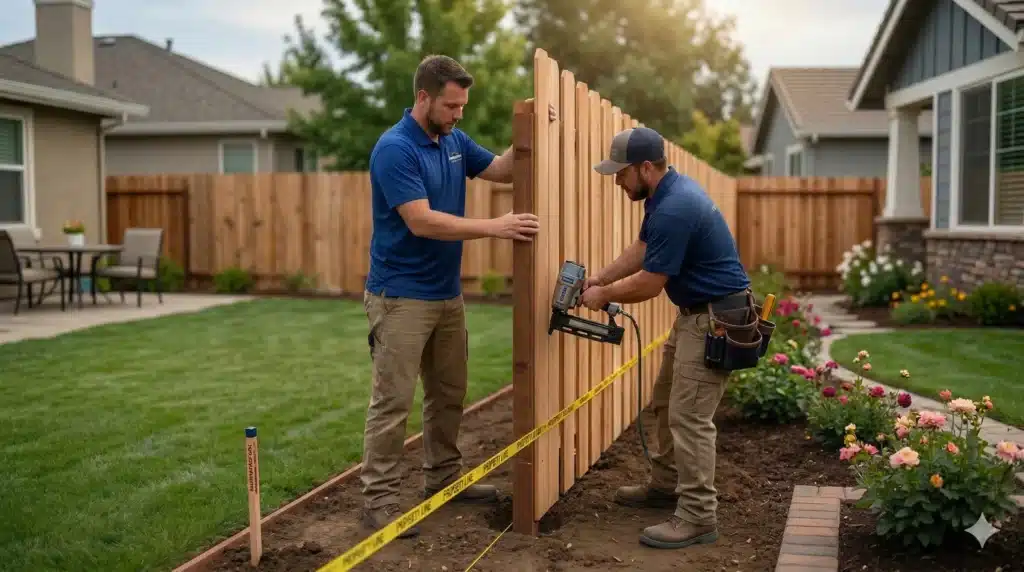
When we get both neighbors onboard early in the process, several important things happen. First,
everyone agrees on where the fence is going, which eliminates disputes before they start. Second-and
this is a big one from a practical standpoint-it allows our crew to work from both sides ofthe fence during
installation. Being able to access both properties makes a significant difference in the quality and
efficiency ofthe work. Setting posts, aligning rails, and attaching pickets is simply easier and produces a
better result when our installers aren’t limited to working from just one side.
There’s another benefit that goes beyond the fence itself: getting to meet another member ofthe
community. We take pride in the work we do, and every shared fence project is an opportunity to introduce ourselves to a neighbor who might need fence work oftheir own down the road. We’ve built countless
relationships across Citrus Heights, Folsom, and Lincoln that started with a simple introduction during a
neighbor’s fence project. When you do quality work and treat people with respect, word gets around.
California's Good Neighbor Fence Law: What You Need to Kno

California has a specific statute that governs shared boundary fences, and every homeowner should be
familiar with it. It’s called the Good Neighbor Fence Act of 2013, codified as California Civil Code Section
841. Here’s what the law says in plain terms.
The law creates a presumption that adjoining landowners share an equal benefit from any fence that
divides their properties. Because ofthat presumption, both property owners are assumed to be equally
responsible for the reasonable costs of building, maintaining, or replacing the fence-unless both parties
have a written agreement that says otherwise.
This is important because it means that if you want to build a new fence on the property line or replace an
existing one, California law expects both neighbors to share the cost equally. lt also means that when a
shared fence falls into disrepair, both neighbors have a legal responsibility to contribute to fixing it.
The 30-Day Written Notice Requirement: Before starting any work on a shared boundary fence, the homeowner initiating the project must provide their neighbor with a written notice at least 30 days in advance. This notice needs to include a description ofthe problem or reason for the new fence, the proposed solution, estimated costs, how the costs would be shared, and a proposed timeline for the work. This notice requirement exists to give the neighbor time to review the plan, discuss it, and raise any concerns before construction begins.
While we always encourage homeowners to maintain open, friendly communication with their neighbors
about fence projects, it’s worth knowing that this written notice step is a legal requirement under California
law-not just a suggestion. Skipping it could affect your ability to collect your neighbor’s share ofthe cost
if a dispute arises later.
Cost Sharing: How the 50/50 Split Works
Under the Good Neighbor Fence Law, the default arrangement is a 50/50 cost split between neighbors for
a boundary fence. This covers construction ofa new fence, necessary repairs to an existing one, and full
replacement when the fence has reached the end of its useful life.
However, the law does include some important exceptions. A neighbor can argue that they should pay
less than half-or nothing at all-if they can demonstrate that the financial burden would be substantially
disproportionate to the benefit they receive from the fence, or that the costs are unreasonable. For
example, ifone neighbor insists on premium materials that are far more expensive than what’s standard
forthe neighborhood, the other neighbor generally cannot be forced to pay for that upgrade. The law specifically calls out that costs driven by personal aesthetic or architectural preferences may not be
equally shared.
In our experience working with homeowners in Rocklin, Lincoln, and across the Sacramento region, most
neighbors are happy to split the cost once they understand the benefits-a new fence improves the look,
privacy, and value ofboth properties. We find that when we present a fair, straightforward estimate and
explain how the project benefits both sides, the conversation almost always goes smoothly.
Do You Need a Property Survey

One ofthe most common concerns homeowners have about building on a property line is whether they
know exactly where that line is. Ifthere’s any uncertainty about the boundary, a professional property
survey is the only way to know for sure.
We recommend a property survey whenever theres any doubt about where the property line actually falls.
In many cases, especially in established neighborhoods throughout Roseville, Citrus Heights, and Folsom,
the property line is already well-defined by existing fences, survey stakes, or markers that were placed
when the homes were built. When both neighbors agree on the boundary and there are clear reference
points, a new survey may not be necessary.
But if there’s any disagreement, if you can’t find existing survey markers, or if you’re dealing with an older
property where the boundaries aren’t clearly established, investing in a professional survey is well worth
the cost. A licensed land surveyor will locate and mark the exact boundary using advanced equipment and
legal records. The cost typically runs a few hundred to over a thousand dollars depending on the property,
but that’s a fraction ofwhat it would cost to tear out and rebuild a fence that turns out to be on the wrong
side of the line.
You may also already have a survey from when you purchased your home. Mortgage lenders frequently
require a property survey as part ofthe closing process, SO check your closing paperwork-you might find
one already sitting in a filing cabinet. Your local county assessors office can also provide plat maps that
show general property boundaries, though these are typically less precise than a full boundary survey.
What IfYour Neighbor Doesn't Agree?
In a perfect world, both neighbors enthusiastically agree on the fence project and split the cost. But
sometimes that doesn’t happen. Maybe your neighbor doesn’t want a new fence. Maybe they disagree on
the style or materials. Maybe they simply dont want to pay.
If youve provided proper written notice under the Good Neighbor Fence Law and your neighbor refuses to
participate, you still have options. The most straightforward solution is to build the fence entirely on your
own property, set back a few inches from the property line. This way, the fence is 100% yours-you own
it, you maintain it, and you dont need your neighbor’s permission or contribution. The trade-off is that a small strip of your property will technically be on the other side ofthe fence, and you won’t have the
benefit ofyour neighbor’s cooperation during installation.
If the existing shared fence is in disrepair and your neighbor is refusing to contribute to necessary repairs
or replacement, you may have legal remedies under Civil Code 841. The law allows you to pursue the
matter in small claims court to recover your neighbor’s share. However, we always encourage
homeowners to try direct communication first. In our experience, most disagreements between neighbors
come down to miscommunication or misunderstanding, and a friendly conversation often resolves things.
We’ve seen plenty of situations in Lincoln and Folsom where a hesitant neighbor came around once they
understood the project details and saw the value it would bring to their property too.
The "Good Side" and "Bad Side" ofthe Fence

Ifyouve ever looked at a wood fence, youve probably noticed that one side looks nicer than the other.
The “good side”-the flat, finished face ofthe pickets-typically faces outward toward the neighbor or the
street, while the “bad side” showing the rails and post structure faces the homeowner who paid for the
fence. This is actually a common courtesy and, in some areas, a code requirement.
When a fence is built directly on the property line as a shared structure, the question ofwhich side faces
which neighbor becomes an important conversation. Since both neighbors are co-owners ofthe fence,
both have a stake in how it looks from their side. This is one more reason why we always involve both
parties early in the planning process-its much easier to agree on materials and style before the fence
goes up than to argue about it afterward.
There are also fence styles that look the same on both sides, sometimes called “good neighbor” or
“shadowbox” designs, where pickets alternate on either side ofthe rail so both neighbors see a finished
face. These can be a great option for shared boundary fences and are popular across communities in
Roseville and Rocklin where homeowners want an attractive look from every angle.
HOA Rules and Local Permi
Before building any fence-whether on the property line or not-you need to check two things: your local
city or county building codes and your homeowners association (HOA) rules, if you have one.
California generally limits residential fences to 3.5 to 4 feet in front yards and 6 feet in backyards, but
individual cities may have their own regulations. Roseville, Rocklin, Lincoln, Citrus Heights, and Folsom
each have their own municipal codes governing fence height, setbacks, materials, and whether a permit is
required. Some communities have additional restrictions on corner lots where sight lines for drivers and
pedestrians need to be maintained.
HOA rules can be even more specific. Many HOAs in planned communities throughout Placer and
Sacramento counties dictate the exact style, color, material, and height offences allowed in the neighborhood. Ifyour property is governed by an HOA, getting approval before you build is not
optional-it’s required. Building a fence that violates HOA rules can result in fines and a requirement to
remove or modify the fence at your own expense.
Pro tip: At Fantastic Fence, were familiar with the local codes and common HOA requirements across the communities we serve. When you work with us, we help walk you through the permitting process and make sure your fence project is compliant from the start. It's one less thing for you to worry about.
A Word About Spite Fence

While we’re on the topic offences and neighbor relations, it’s worth mentioning that California law
specifically prohibits what are known as “spite fences.” Under California Civil Code Section 841 .4, any
fence or structure in the nature ofa fence that unnecessarily exceeds 10 feet in height and is maintained
for the purpose ofannoying the owner ofan adjoining property is considered a private nuisance. The
affected neighbor has the legal right to take action against the person who built it.
This is a relatively rare situation, but it’s a good reminder that fences should be built to benefit your
property-not to create problems with your neighbors. In our experience, a well-planned fence project that
includes the neighbor in the conversation from the beginning almost always results in a positive outcome
for everyone involved.
The Bottom Line: Communication Makes Everything Easie
Building a fence on a property line is absolutely possible, and it’s done every day across communities in
Roseville, Rocklin, Lincoln, Citrus Heights, and Folsom. The single most important factor in making it go
smoothly is communication. Talk to your neighbor before you start. Share your plans. Listen to their input.
Understand your shared responsibilities under California’s Good Neighbor Fence Law. And if there’s any
uncertainty about where the property line falls, invest in a survey to get a definitive answer.
When both neighbors are involved and onboard, the result is a better fence, a smoother installation
process, and a stronger relationship with the person living on the other side ofthat fence. That’s the kind
ofoutcome we aim for on every project.
Planning a Fence on a Shared Property Line
The team at Fantastic Fence has helped hundreds ofhomeowners navigate property line fences-from the first conversation with the neighbor to the final walk-through. We handle the details so you dont have to.
Call Us: (916) 790-7100 | www.caIIfantasticfence.com
Proudly serving Roseville, Rocklin, Lincoln, Citrus Heights, Folsom, and surrounding communities.