
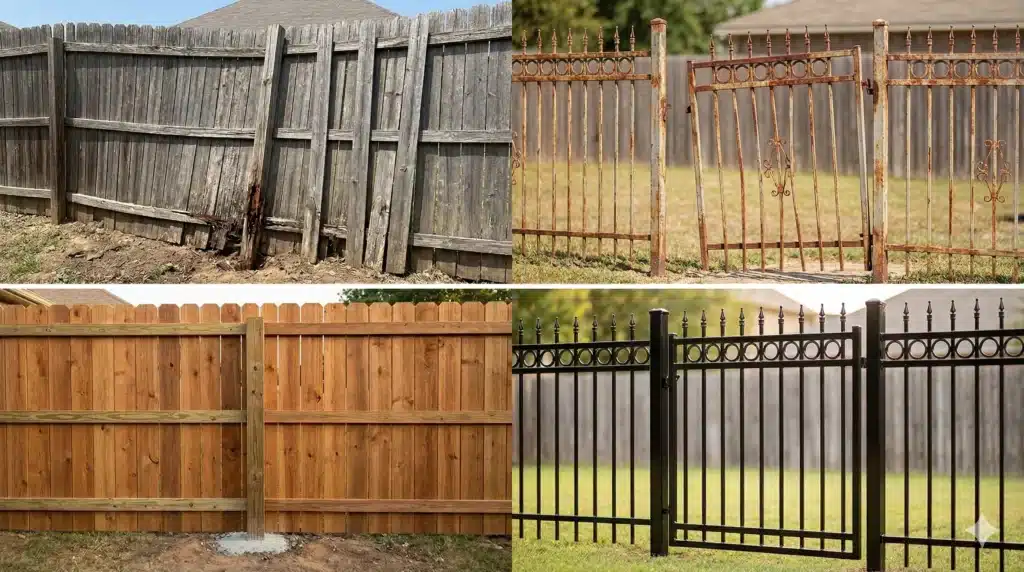
A guide from your local Sacramento-area fence experts at Fantastic Fence
Every fence has a lifespan, and somewhere along the way, things start to break down. Whether
you own a wood privacy fence or an ornamental iron fence, certain repair issues come up time and
time again. At Fantastic Fence, we’ve been handling fence repairs across Sacramento, El Dorado
Hills, Citrus Heights, Auburn, and Natomas for years, and we’ve seen just about everything. Here
are the most common fence repair problems we encounter—and what it actually takes to fix them
the right way.
1. Rotten or Broken Fence Posts

If there’s a single repair issue that tops the list, it’s rotten fence posts. Posts are the backbone of your
entire fence, and they take a beating. The section of the post that sits at or just below ground level is
constantly exposed to moisture, and over time—even with pressure-treated lumber—that moisture causes
rot. Once the post weakens, the entire fence section starts to lean, sag, or even collapse.
We see this constantly across the Sacramento region. The hot, dry summers followed by wet winters
create a cycle of expansion and contraction in the soil that accelerates post deterioration. In
neighborhoods throughout Citrus Heights and Natomas, where many homes were built in the same era,
it’s common for entire streets to start experiencing post failures around the same time.
The fix for a rotten post depends on the severity. If rot is limited to the base, we can sometimes use a
metal post bracket or concrete repair spur to reinforce what’s still solid. But in most cases, the post needs
to come out entirely and be replaced with a new one set properly in concrete. We dig the hole to the
correct depth, use quality pressure-treated lumber, and ensure proper drainage around the footing so the
new post lasts as long as possible.
2. Gates That Don’t Swing or Latch Properly
A gate that drags on the ground, won’t latch, or swings open on its own is one of the most frustrating fence
problems homeowners deal with. And the root cause is almost always the gate posts—not the gate itself.
Here’s what we see all the time: gate posts are typically made from pressure-treated wood, and
pressure-treated lumber has a well-known tendency to twist and warp as it dries out after installation.
When a gate post twists even a small amount, it throws the entire gate out of alignment. The hinges bind, the latch no longer lines up, and the gate starts dragging or won’t close at all.
We get calls about this frequently from homeowners in El Dorado Hills and Auburn who have relatively
new fences—sometimes only a year or two old—where the gate has already stopped working properly. It’s
not that the gate was built wrong. The posts shifted. Pressure-treated wood is still wet with chemical
preservative when it’s installed, and as it dries, it moves. If the wood came from near the center of the log
where the growth rings are tightest, it’s even more prone to twisting.
The solution usually involves resetting or replacing the gate posts, realigning the hinges, and sometimes
rebuilding the gate frame itself if it has gone out of square. In some cases, we can shim the hinges or
adjust hardware to compensate, but if the post has twisted significantly, replacement is the most reliable
long-term fix.
3. Fence Boards Falling Off — The Wrong Nail Problem

This one drives us crazy because it’s entirely preventable. We regularly show up to repair fences where
the pickets are popping off the rails, and the culprit is almost always the same: the original installer used
smooth interior nails instead of the proper fastener.
Fence pickets should be installed using ring shank hot-dip galvanized nails. The difference between a
ring shank nail and a smooth nail is night and day when it comes to holding power. A ring shank nail has a
series of ridges—like small rings—running along the shaft. When you drive a ring shank nail into wood,
those ridges dig into the wood fibers and create friction that locks the nail in place. The wood essentially
grips around each ring, making it extremely resistant to pulling out. Studies show that ring shank nails
require roughly 40% more force to extract than a smooth shank nail of the same size.
A smooth nail, by contrast, relies only on the friction of its flat surface against the wood. As the wood
expands and contracts through seasonal moisture changes—and we get plenty of that here in
Sacramento—smooth nails slowly work their way back out. One by one, pickets start loosening and
eventually fall off entirely.
Why “hot-dip galvanized” matters: The hot-dip galvanization process coats the nail in a thick layer of zinc that resists corrosion far longer than cheaper electro-galvanized nails. Electro-galvanized nails can start showing rust and streaking within months, especially in contact with pressure-treated wood. Hot-dip galvanized ring shank nails give you the best combination of holding power, corrosion resistance, and long-term value—and they’re still more affordable than screws.
If your fence boards are falling off because of smooth nails, the repair is straightforward: we re-secure the
pickets with proper ring shank hot-dip galvanized nails. It’s a relatively simple fix that dramatically extends
the life of the fence.
4. Rotten Rails — The “Rail Bridge” Fix
The horizontal rails on a wood fence are the structural skeleton that everything hangs on. Typically you
have two or three rails running between posts, and all of your pickets are nailed to these rails. When a rail
rots, the consequences are obvious: pickets start falling off, entire panels sag, and sections of the fence
can come down.
Rail rot tends to happen in spots where moisture collects—where the rail meets the post, or along the
bottom rail where it’s closest to the ground and any standing water or sprinkler spray. We see this
frequently in older neighborhoods across Sacramento and Natomas where fences are 10 to 15 years old
and the original wood is reaching the end of its life.
Now here’s the thing about replacing a rotten rail: you can’t just pull it out and slide in a new one. Every
picket on that section of fence has nails driven through it into that rail—we’re talking about 100 nails or
more on a single rail span. Trying to remove all those nails, pull the old rail out, and re-nail everything is
impractical and risks damaging the pickets in the process.
Instead, we use what we call a rail bridge. The concept is simple but effective: we install a new rail
directly above or below the rotted one, securing it to the posts and then fastening the pickets to this new
rail. Think of it like a splint on a broken bone. The new rail takes over the structural load, and the old rotted
rail is essentially retired in place. A properly installed rail bridge will hold just as long—if not longer—than
the rest of the fence, and it saves the homeowner the significant cost and hassle of tearing out and
rebuilding the entire section.
5. Rust on Metal and Iron Fences

Metal fences—whether wrought iron, steel, or chain link—are built to last, but they’re not
maintenance-free. The number one enemy of any metal fence is rust. Once rust takes hold, it spreads,
weakening the metal and leaving behind an ugly orange-brown stain.
The good news is that rust is one of the easiest fence problems to prevent if you stay on top of it. We
recommend that homeowners with metal fences do a yearly walk-along inspection. Look closely at every
joint, weld, and connection point—these are the areas where moisture collects and the protective coating
tends to fail first. Any time you spot rust forming, address it immediately.
The process is straightforward: use a wire brush to scrub away all loose rust and flaking paint, then apply
a rust-inhibiting primer followed by an exterior metal paint or spray. Catching rust spots early and hitting
them with a wire brush and a can of rust-inhibiting spray once a year goes a remarkably long way toward
preserving the life and appearance of your metal fence. It’s a small investment of time that prevents
expensive section replacements down the road.
For homeowners in Auburn and El Dorado Hills where properties are surrounded by oak trees and natural
landscape, keep an eye on where vegetation contacts the fence. Plants and vines trap moisture against
the metal and accelerate corrosion. Trimming back vegetation and ensuring good airflow around your
metal fence is one of the simplest maintenance steps you can take.
6. Vehicle Damage and Tree Damage
This is a call we get more often than you might think. A car backs into the fence. A tree limb comes down
in a storm. A large branch falls and crushes an entire section. The result is usually a mangled, bent, or
splintered mess that looks like it needs a full replacement—but often it doesn’t.
Vehicle and tree damage repairs are what we call surgical work. We come in, carefully cut out only the
damaged section—whether it’s a few bent metal pickets, a crushed panel, or a snapped post—and
replace just that portion with new materials matched to the existing fence. The goal is to make the repair
blend seamlessly with the rest of the fence so you’d never know anything happened. Remove the
damaged piece, install the replacement, and move on.
This approach saves homeowners significant money compared to replacing large sections unnecessarily.
In areas like Citrus Heights and Natomas where mature trees are common along fence lines, we
recommend periodically checking for dead or overhanging limbs that could come down in a wind event. A
little preventive tree trimming can save you a fence repair bill later.
Signs Your Fence Needs Attention Now

Not sure whether your fence needs repair? Here are some red flags to watch for: posts that wobble when
you push on them, a gate that has started dragging or won’t latch, boards that are loose or missing, rails
that feel soft or spongy when you press on them, visible rust spots on metal fencing, or sections that are
leaning noticeably in one direction. Any of these issues will only get worse with time, and addressing them
early almost always costs less than waiting until the problem compounds.
Need a Fence Repair? We’re Here to Help.
Whether it’s a single rotten post or a full section knocked down by a fallen tree, the team at Fantastic Fence has the experience to diagnose the problem and fix it right the first time.
Call Us: (916) 790-7100 | www.caIIfantasticfence.com
Proudly serving Sacramento, El Dorado Hills, Citrus Heights, Auburn, Natomas, and surrounding communities.