A safety guide for pool owners in Sacramento and Placer County from Fantastic Fence
If you own a swimming pool in California, the fence and gate surrounding it aren’t just about privacy
or curb appeal—they’re a legal requirement designed to protect children’s lives. California has
some of the most detailed pool barrier laws in the country, and for good reason: according to the
CDC, drowning is the leading cause of unintentional injury-related death for children ages one to
four. A properly installed, code-compliant pool fence and gate is the single most effective barrier
between a curious child and a potentially fatal accident. At Fantastic Fence, we help homeowners
across Sacramento and Placer County understand these requirements and make sure their pool
areas are safe and compliant.
Why Pool-Compliant Fencing Matters This Much
Before we get into the technical specifications, it’s important to understand why California takes pool
fencing so seriously. A swimming pool is one of the most dangerous features on any residential property,
particularly for young children who don’t understand the risks. A toddler can slip out a back door, wander
into a neighbor’s yard, or find their way to an unfenced pool in a matter of seconds—and a drowning can
happen silently in as little as two minutes.
This is exactly the kind of scenario that pool safety laws are designed to prevent. Every requirement you’ll
read about in this article—the fence height, the latch placement, the gap restrictions, the self-closing
hinges—exists because it addresses a specific way a small child could gain unsupervised access to a
pool. These aren’t arbitrary rules. They’re built on decades of data about how drowning accidents actually
happen.
What Is an “Attractive Nuisance” and Why Should You Care?
You may have heard the legal term “attractive nuisance” before, but here’s what it means in plain English:
an attractive nuisance is something on your property that is dangerous but also naturally appealing to
children—something that might draw a child onto your property even without an invitation. Swimming
pools are the textbook example. Kids see water and they want to play in it. They don’t understand the
danger, and they don’t care that it’s someone else’s backyard.
Here’s the part that surprises a lot of homeowners: even if a child trespasses onto your property uninvited
and is injured or drowns in your pool, you can still be held legally responsible. The law recognizes that
children are too young to appreciate the risks, and it places the responsibility on property owners to take
reasonable steps to prevent unsupervised access to known hazards. An unfenced or improperly fenced
pool is considered a foreseeable danger—and if something happens, the homeowner may face serious
legal and financial consequences.
While California technically moved away from the formal “attractive nuisance doctrine” in 1970, the
underlying principle remains deeply embedded in the state’s premises liability laws. California property
owners have a general duty of care to maintain their property in a reasonably safe condition—and courts
routinely consider whether hazards like unsecured pools were foreseeable and whether the owner took
adequate precautions. In practice, the outcome is the same: if your pool is not properly secured and a
child is harmed, you are very likely to be held liable
The bottom line: A pool-compliant fence and gate aren’t just about passing an inspection. They’re your primary legal defense against liability and—far more importantly—they are the physical barrier that could prevent a child from drowning. This is as serious as it gets
California’s Pool Safety Act: The Legal Framework
California’s Swimming Pool Safety Act, updated most recently through SB 442 in 2018, sets the rules that
every residential pool owner must follow. The law applies to any pool or spa containing water deeper than
18 inches—whether it’s in-ground, above-ground, or even a permanent hot tub. You can read the full text
of the law at the California Swimming Pool Safety Act (Health & Safety Code, Article 2.5).
Under the current law, any new pool construction or permitted pool renovation must include at least two
approved safety features in addition to a standard perimeter fence. Homeowners must choose at least two
from the following list: an enclosure (fence or wall) that completely isolates the pool from the home, a
removable mesh pool fence meeting ASTM F2286 standards, an approved safety pool cover, exit alarms
on doors that open to the pool area, self-closing and self-latching devices on doors providing direct pool
access (with the latch placed no lower than 54 inches above the floor), or a pool alarm that detects
unauthorized entry into the water.
For homeowners in Sacramento and Placer County, this means that if you’re building a new pool,
resurfacing an existing one, or doing any permitted renovation work, your pool area will be inspected for
compliance with these requirements before you receive final approval. This is non-negotiable—your
project will not pass final inspection without at least two qualifying safety features in place.
Pool Gate and Fence Requirements: The Specifics
The technical requirements for pool-compliant fences and gates in California are very specific, and every
detail matters. Here’s what the code requires, broken down into plain language:
Fence Height: The pool barrier must be a minimum of 60 inches (5 feet) tall, measured from the exterior
side—the side facing away from the pool. This height is specifically designed to prevent a young child
from climbing over the barrier.
Gap at the Bottom: The maximum vertical clearance between the ground and the bottom of the fence
cannot exceed 2 inches. This prevents a child from crawling underneath. If your fence has settled or the
ground has eroded and there’s a gap larger than 2 inches, your fence is out of compliance.
Gaps Between Pickets or Slats: No opening in the fence can be large enough to allow a 4-inch diameter
sphere to pass through. This is sometimes called the “4-inch sphere rule,” and it’s designed to prevent a
small child’s head and torso from fitting through the fence. If your pickets have shifted, warped, or been
damaged, the gaps between them may have widened beyond the 4-inch limit.
No Climbable Features: The outside surface of the fence—the side facing away from the pool—must be
free of any protrusions, cavities, or features that a child under five years old could use as handholds or
footholds to climb over. This means no horizontal rails on the exterior, no decorative elements that create
a ladder effect, and no nearby objects like chairs, planters, or play equipment that could be used as a
boost.
Gate Must Open Away From the Pool: All access gates through the pool enclosure must swing outward,
away from the pool area. This ensures that a child pushing against the gate from the pool side cannot
accidentally push it open.
Self-Closing Gate: The gate must close and latch on its own every single time, without anyone needing
to push it shut. This is typically accomplished with spring-loaded or hydraulic hinges that automatically pull
the gate closed after it’s been opened. If your gate hinges are worn out, rusted, or out of adjustment and
the gate doesn’t reliably close on its own, it’s not compliant.
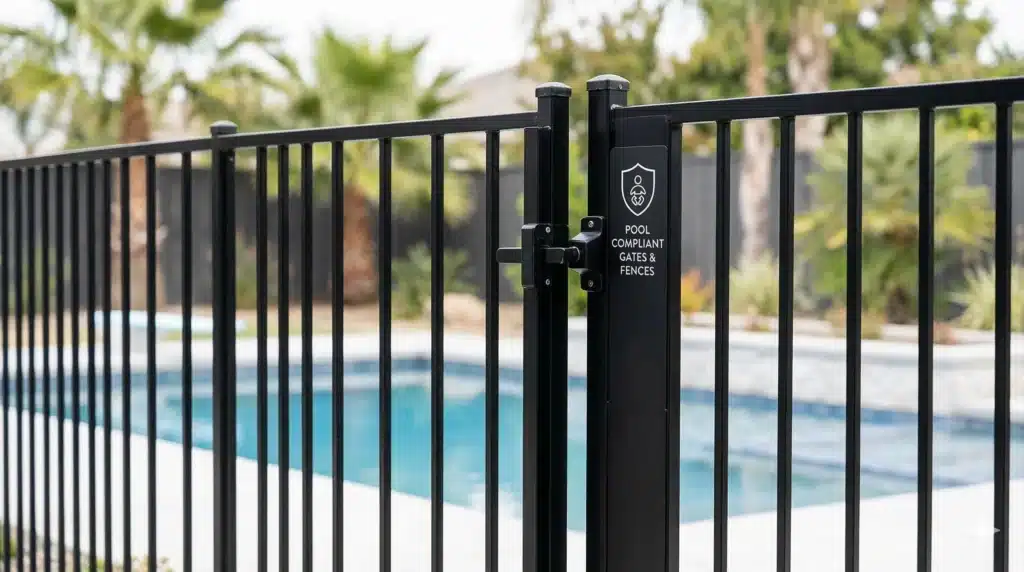
Self-Latching Gate: The gate must have a latch that engages automatically when the gate closes. You
should not have to manually flip, slide, or lock anything for the gate to be secured. The latch must catch
and hold on its own.
Latch Height: This is one of the most commonly failed requirements we see. For a pool enclosure gate
(the fence around the pool), the self-latching device must be placed no lower than 60 inches (5 feet)
above the ground. For doors from the home that provide direct access to the pool area, the self-latching
device must be placed no lower than 54 inches above the floor. These heights are calculated to be out of
reach for young children. If your latch is mounted at a standard gate height of 36 to 42 inches, it does not
meet pool code—a child can reach it.
Quick reference for pool-compliant gates and fences: Minimum fence height: 60 inches (5 feet). Maximum gap under fence: 2 inches. Maximum gap between pickets: less than 4 inches. Gate must open away from pool. Gate must be self-closing and self-latching. Gate latch height: 60 inches minimum on pool enclosure gates, 54 inches minimum on house doors to pool. No climbable features on exterior surface.
When Do Pool Compliance Issues Get Caught?
Many homeowners with existing pools have had non-compliant gates or fences for years without realizing
it. The issue typically comes to light during one of three situations, and all of them are becoming more
frequent across Sacramento and Placer County.
Pool Resurfacing or Renovation: This is the most common trigger we see. When you pull a permit to
resurface your pool, add new coping, update the decking, or make any significant modification, the city or
county building inspector will check your entire pool area for compliance with the current Pool Safety Act
before issuing final approval. If your fence or gate doesn’t meet current code, your project will not pass
inspection until the issues are corrected. Many homeowners are caught off guard by this—they came in
for a cosmetic update and now they need gate and fence work before the project can be signed off.
New Pool Installation: When a brand-new pool is being built, the pool contractor and the building
department will verify that the surrounding fence and gates meet all current requirements. This is part of
the standard permitting and inspection process. If your existing perimeter fence is older and doesn’t meet
current pool code specifications, it will need to be brought up to standard before the pool project receives
final approval.
Annual Homeowner’s Insurance Inspections: Insurance companies are inspecting pool properties at
an increasing rate, and pool barrier compliance is one of the first things they check. If an insurance
inspector finds that your pool fence or gate doesn’t meet code—whether it’s a latch that’s too low, a gate
that doesn’t self-close, or gaps that are too wide—you may receive a notice requiring you to correct the
issue within a specified timeframe. In some cases, failure to comply can result in a policy cancellation or
non-renewal. Insurance companies understand the liability exposure that a non-compliant pool creates,
and they are not willing to carry that risk.
The Most Common Compliance Problems We Fix
At Fantastic Fence, we see the same compliance issues come up over and over again on pool properties
throughout Sacramento and Placer County. Understanding these common problems can help you identify
whether your own pool area might need attention.
The number one issue is gate latches mounted too low. Older fences and gates were often installed
with standard latches at 36 to 42 inches—fine for a regular yard gate, but well below the 60-inch minimum
required for pool enclosures. Bringing this into compliance usually means installing a new latch
mechanism at the correct height or, in some cases, replacing the gate entirely if it can’t accommodate the
higher latch position.
Close behind is gates that no longer self-close or self-latch. Over time, hinges wear out, springs lose
tension, and latches get bent or corroded. A gate that worked perfectly five years ago may now swing
open and stay open—which completely defeats the purpose of the barrier. We replace worn-out hinges
and latch hardware regularly to bring gates back into working compliance.
We also frequently see gaps that have grown too large, either under the fence where the ground has
settled or eroded, or between pickets that have warped, shifted, or broken over time. A gap that was 3
inches when the fence was new can easily become 5 inches a few years later as wood ages and moves.
Any gap larger than 4 inches between pickets—or larger than 2 inches at the bottom of the fence—is a
failed inspection.
Other common issues include gates that open inward toward the pool (they must open outward),
climbable features on the fence exterior such as horizontal rails or decorative elements, and objects
placed near the fence that a child could stand on to boost themselves over—outdoor furniture, storage
bins, playground equipment, or even large planters.
How Fantastic Fence Brings Your Pool Area Into Compliance
When a homeowner contacts us about pool compliance—whether it’s because they’ve been flagged by an
inspector, notified by their insurance company, or simply want to get ahead of the issue—we start with a
thorough evaluation of the entire pool barrier. We check every specification: fence height, gap
measurements, gate swing direction, hinge function, latch height and operation, and the exterior surface
for climbable features.
In many cases, bringing a pool fence into compliance doesn’t require a full fence replacement. Often, the
fix involves replacing gate hardware with code-compliant self-closing hinges and a self-latching
mechanism at the correct height, adjusting or replacing sections where gaps have widened, adding a
board or trim piece at the bottom to close ground-level gaps, or modifying the gate to swing in the correct
direction. We tailor the solution to your specific situation and aim to address the issue as efficiently and
affordably as possible while meeting every code requirement.
If your fence is older and has multiple compliance issues—or if the structure itself is deteriorating—a full
replacement with a purpose-built pool-compliant fence may be the better investment. We’ll walk you
through the options and help you make the decision that makes sense for your property and your budget.
Don’t Wait for an Inspector to Tell You
The best time to address pool fence and gate compliance is before you’re in the middle of a renovation, a
permit process, or an insurance review. If you have a pool and you’re not 100% sure your fence and gate
meet current California code, it’s worth getting it checked now.
Walk out to your pool area and ask yourself these questions: Does the gate close and latch completely on
its own every time? Is the latch at least 5 feet off the ground? Does the gate swing away from the pool?
Are there any gaps under the fence larger than 2 inches? Could a child’s head fit between any of the
pickets? Is there anything on the outside of the fence a child could climb on? If the answer to any of these
questions raises a concern, give us a call.
At the end of the day, pool fencing compliance isn’t about paperwork or passing inspections—it’s about
keeping kids safe. Every requirement in the code exists because it addresses a real-world scenario where
a child gained access to a pool and was seriously harmed or killed. A functioning, properly installed,
code-compliant gate and fence is the most important safety feature your pool can have. It is worth doing
right.
Official Pool Safety Resources and Links
For homeowners who want to review the official regulations themselves, here are the key resources for
California pool fence and gate compliance in our service area:
California Swimming Pool Safety Act (Full Text)
leginfo.legislature.ca.gov – Health & Safety Code, Article 2.5
The full text of the California Swimming Pool Safety Act, including all fence, gate, and safety feature
requirements for residential pools statewide.
Placer County – Pool Enclosure Requirements
placer.ca.gov – Pool Enclosure Requirements (PDF)
Placer County Building Services Division’s official handout covering pool enclosure, fence, and gate
requirements specific to unincorporated Placer County properties, including Auburn, Granite Bay, and
surrounding areas.
City of Sacramento – Swimming Pool Requirements
cityofsacramento.gov – Swimming Pool Requirements (PDF)
The City of Sacramento Community Development Department’s official pool requirements document,
including detailed fence, gate, and safety feature specifications for residential pools within city limits.
Sacramento County – Residential Pool Requirements
building.saccounty.gov – SP-08 Residential Pool Requirements (PDF)
Sacramento County’s building department handout covering residential pool enclosure, access gate, and
safety feature requirements for properties in unincorporated Sacramento County.
FindLaw – California Civil Code Section 841 (Pool Fence Reference)
findlaw.com – Property Line and Fence Laws in California
A helpful overview of California fence laws for general reference, including property line and shared fence
responsibilities that may intersect with pool barrier requirements.
Need Your Pool Fence or Gate Brought Up to Code?
Fantastic Fence helps homeowners across Sacramento and Placer County evaluate, repair, and replace
pool fences and gates to meet California’s Swimming Pool Safety Act requirements. Whether you need a
simple latch upgrade or a complete pool enclosure, we’ll make sure it’s done right.
Call Us: (916) 790-7100 | www.callfantasticfence.com
You’re busy. We make fences easy.