Key Takeaway
Electric fencing 101 starts with one core principle: an electric fence works as a psychological barrier, not a physical wall, delivering high-voltage pulses over 5,000 volts lasting 1/300 of a second to teach avoidance in a single lesson. The system has three essential parts: an energizer, a conductor, and a ground system. Around Sacramento, it is used mainly for livestock containment on acreage and commercial theft prevention behind a standard perimeter fence.
An electric fence isn’t a physical wall. It’s a psychological barrier, a mental barrier that works between the animal’s ears rather than through brute force. It doesn’t stop an animal or a person by force. It teaches them, once, that touching it is unpleasant, and then it keeps working because nobody wants a second lesson. That single idea explains where electric fencing succeeds and where it fails. Around the Sacramento region, we see electric fence used two ways that look almost nothing alike: horse and livestock containment on acreage, and commercial theft prevention behind a standard perimeter fence. A quick note before we go further: Fantastic Fence doesn’t install electric fencing or electrified security systems. We build the field fence, agricultural fence, and commercial chain link they attach to and sit behind. Questions about that fence underneath? Call (916) 790-7100.
What Is an Electric Fence? A Psychological Barrier, Not a Wall

This is electric fencing 101 at its simplest: the whole concept rests on one thing, teaching avoidance. A well-designed electric fence doesn’t restrain an animal. It gives a short, uncomfortable electric shock the first time the animal makes contact with the electrified wire, and a trained animal spends the rest of its life keeping its distance. One lesson, then respect. Animals learn fast, which is exactly why this approach beats fighting them with more steel.
That principle is why the two local use cases feel so different. On a horse property, the goal is behavior control on an animal you can train. On a commercial yard, the goal is deterring an intruder after hours. Same physics, very different setups. According to Virginia Cooperative Extension, an energizer produces high voltage of over 5,000 volts in pulses lasting about 1/300 of a second, with the fence wire dead between pulses. That pulsing is exactly what makes it a deterrent and not a hazard. Because it’s a low amperage system, the electric current stings without doing lasting harm.
Electric Fencing 101: How It Works and When It Makes Sense as a Three-Part System
Every electric fence has three parts, and the third is the one people get wrong. Understanding how electric fence work is really about understanding how the energizer, ground rods, insulators, and conductor move current in a loop.
The energizer, or fence charger
Also called a charger or fencer, the fence charger is the box that takes power in and sends a short, high voltage pulse down the wire roughly once every one to two seconds. Plug-in units draw from a wall outlet. DC units run off batteries, and a solar fence charger pairs a battery with solar panels for remote pasture corners where no power runs. Most models have indicator lights so you can confirm the electric fence delivers a pulse at a glance.
The conductor
The wire, rope, or tape carrying the pulse. Most permanent lines use high tensile smooth wire, though polywire and polytape show up on lighter setups. This fencing material is held away from posts by high quality insulators so the charge doesn’t leak into the ground and drain away before it does any good. Never mix copper wire and galvanized steel at connections, because the two metals corrode against each other and quietly kill your voltage.
The ground system
Here’s the part that causes most failures. The circuit isn’t complete until the animal touches the wire and the current travels through it into the soil and back to the energizer’s ground rods along the ground wire. A metal rod driven deep into moist earth finishes the loop. That’s why a bird can perch on a hot wire and feel nothing: it isn’t grounded, so no circuit forms. A grounded animal standing on the soil completes the path and gets the shock.
Volts vs. Joules: What the Numbers Actually Mean
These two get confused constantly, so it’s worth separating them cleanly.
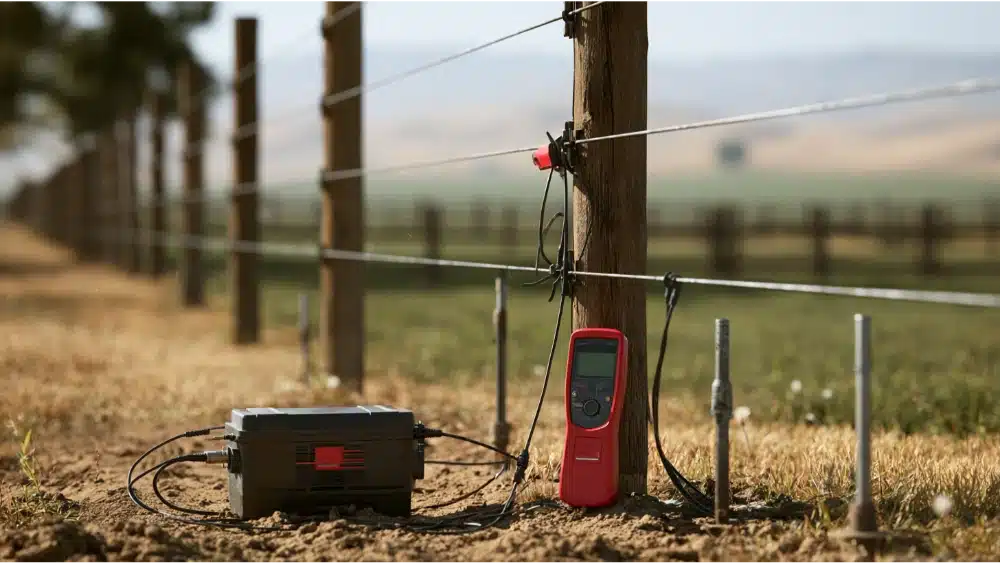
Volts are the push. They measure how hard the high voltage charge drives through hair, hide, and hoof to reach the nerve. A functioning electric fence should read at least 3,000 volts on a tester, and training voltage should run higher. If voltage drops below that, the fence stops teaching.
Joules are capacity. They measure how much energy the energizer can deliver down a long line of fence wire loaded with wet grass and weeds. A conservative rule of thumb is about one joule of output per mile, and per joule of output you can cover roughly 20 to 40 acres. Matching joule output to the length of line you’re running is the sizing decision that trips up most first-timers.
Two cautions when shopping. Compare output joules, not stored joules, since output is commonly around 70% of the stored figure. And manufacturers’ mileage ratings assume a clean, vegetation-free fence, which is why real-world sizing runs well above the number on the box, especially over long distances.
Voltage Targets by Animal (and Why Thick Coats Insulate)
There’s no single correct voltage. The right number depends on the animal, how much its coat insulates, soil moisture, vegetation load, and whether it’s already trained. Meeting the right voltage requirements for each species is the difference between a fence that contains and one that gets tested.
| Animal | Target voltage |
|---|---|
| Horses | 2,500–3,000 V |
| Cattle | ~3,500 V |
| Sheep & goats (heavy coats) | 4,500–7,000 V |
| Pigs | ~5,000 V |
| Predators & deer | 5,000–10,000 V |
Thick wool and hair insulate, which is why sheep and goats with thick insulating coats need substantially more high voltage than horses. Both beef cattle and dairy cattle sit near the middle of the range and train easily. Animals with thick coats insulate the nerve from the charge, so a mild shock that stops a horse may do nothing to a heavily wooled sheep. Virginia Cooperative Extension supports the cattle and sheep figures directly; treat the others as general working ranges. During the initial training period, voltages should run higher than maintenance levels so the animal’s first lesson is unambiguous.
Application One: Fencing Wildlife Out and Keeping Horses and Livestock In
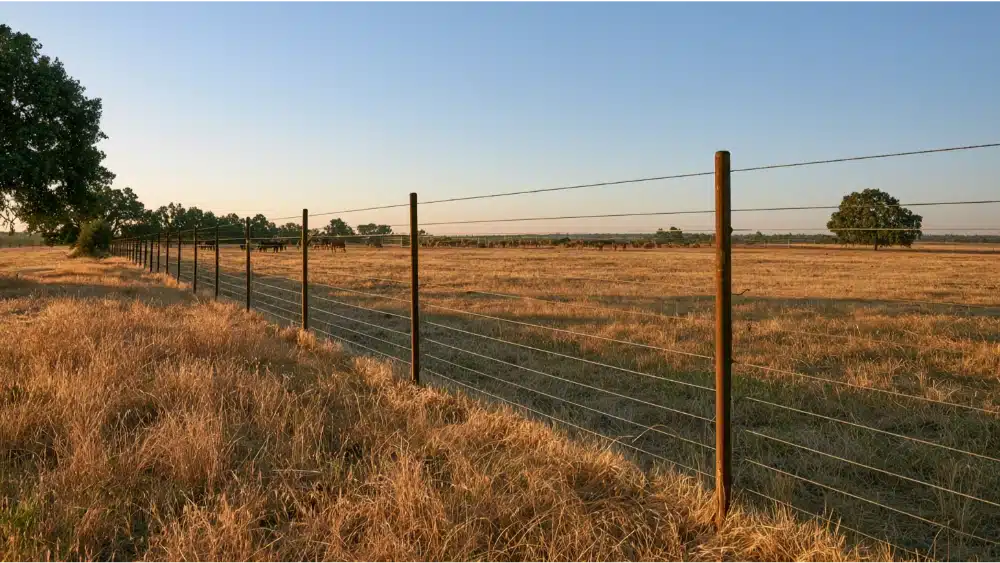
This is the most common local use. A hot wire gets added to good field fence on properties in Loomis, Penryn, Wilton, Granite Bay, and out toward Auburn. A single electric wire riding on top of or in front of the field fence keeps horses off it and stops leaning, cribbing, and reaching through. When you’re fencing wildlife out, such as deer, wild animals pressing a boundary, or wild hogs rooting under a line, the top of the voltage range and lower wires close to the ground are where you want to be.
You’ll see two approaches. Permanent electric fences run high tensile smooth wire on steel or T-posts along a fixed fence line, often using existing fence posts already in the ground, with tight wire spacing near the top where animals reach. Temporary electric fences make it easy to build enclosures for rotational grazing, then move them as the herd shifts pasture. These temporary electric setups usually pair a portable solar fence charger with polywire on plastic posts, and they need only minimal installation tools, so a temporary fence goes up in an afternoon and comes down just as fast. How you space wires depends on the animal and whether you’re running single or multiple wires. Note that a hot wire riding on old barbed wire is a poor combination, since barbed wire snags animals rather than teaching them to back off.
Now the dry-soil reality that matters a great deal here. Our long dry summer weakens grounding, because dry ground and hard clay soil give the current a poor path home and the shock fades. Clay is a poor conductor once it bakes hard. Virginia Cooperative Extension notes that dry western regions often need a continuous earth-return system rather than relying on ground rods alone. And remember: the hot wire is only as good as the physical fence beneath it. That base fence, whether it’s fencing animals in or wildlife out, is the part we build.
Why Electric Fences Fail (Grounding, Dry Soil, and the Ground System)
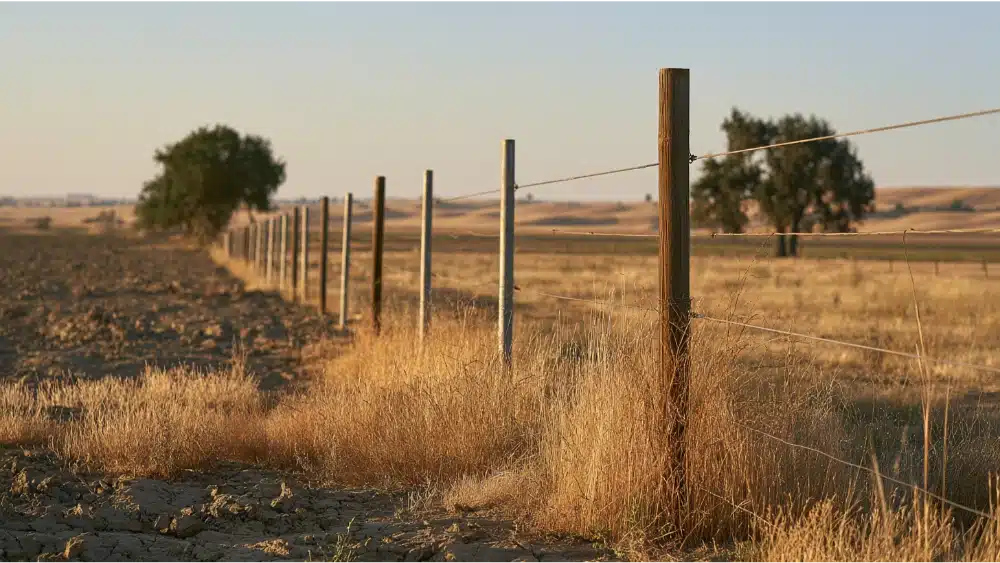
If your fence tests live but doesn’t stop anything, the ground system is the usual suspect. Even a fence installed correctly can fail here. UC Cooperative Extension puts it bluntly: roughly 80% of electric fence problems trace back to a faulty grounding system. The wire reads voltage, but the shock is weak because the current has no good path back to the energizer along the ground wire.
- Poor grounding. Most systems need at least three 6-foot ground rods, spaced about 10 feet apart, galvanized or stainless steel, and sited at least 33 feet from utility poles and building grounds. Running a dedicated ground wire back to those rods keeps the loop clean.
- Dry soil. The Sacramento summer problem. Consider an earth-return system with extra ground rods when the ground dries out.
- Vegetation on the line. Grass and weeds touching the wire bleed voltage straight to ground.
- Undersized fence charger, rusty wire, or broken insulators. Each one quietly steals shock strength, so inspect the fence regularly.
- Untrained animals or a weak base fence. No amount of high voltage fixes a fence that’s already falling over.
One safety note: keep the line clear of dry grass and store batteries properly, since a poorly maintained system carries some fire risk in a dry Sacramento summer. Proper installation help from someone who knows local soil goes a long way.
Application Two: Commercial Theft Prevention and California’s Rules
Different hardware, different rules. A commercial electrified security fence is a second, electrified fence installed behind a standard nonelectrified perimeter fence, protecting equipment yards and vehicle storage from after-hours break-ins. It’s often paired with a monitored alarm. This is where electric fences are used less to contain and more to deter, and most electric fences of this type sit behind chain link.
California layers rules on top of this, and none of what follows is legal advice. Agricultural electric fences fall under the California Food & Agricultural Code, which requires an approved controller as the fence charger. Commercial electrified security fences fall under California Civil Code §835: the electrified fence must sit behind a nonelectrified perimeter fence or wall at least 5 feet high, its height is capped at 10 feet (or 2 feet above the perimeter, whichever is greater), and warning signs must appear at intervals no greater than 30 feet.
Locally, Sacramento County and the City of Sacramento require a 6-foot non-electric surrounding fence in permitted zones, and Elk Grove requires written notice to the fire code official where electrified security fencing is permitted. Rules vary by zoning, use, and fire access. Verify with the City of Elk Grove, Sacramento County, or your local jurisdiction before installing or energizing anything.
When Electric Fencing Makes Sense, and When It Doesn’t
It makes sense when:
- You have trainable animals.
- A strong base fence exists or can be built.
- You can keep vegetation clear of the wires.
- You can build a proper ground system, even in dry soil.
- Your zoning and use allow it, and you’ll test voltage regularly.
- For commercial use, you can meet permit, signage, perimeter, fire-access, and alarm requirements.
It doesn’t make sense when:
- You’re treating it as a DIY residential security shock device.
- Children or the public can easily reach it.
- You only need to discourage small nuisance animals, where traditional fencing methods or a buried wire skirt often work better.
- Local code prohibits it.
- The base fence is weak or already leaning.
- You can’t maintain grounding through the dry season.
- You need a pool safety fence or privacy fence. Those call for a properly built physical barrier, not a deterrent wire.
The Fence Underneath Is the Part That Matters (and Where We Help)
Whether the electric system is a livestock hot wire or a commercial security fence, it depends entirely on the fence it’s mounted to or sits behind. That’s our lane. We build affordable agricultural and field fencing, permanent post-and-wire systems on steel posts, and commercial chain link, plus gate repair and installation across the Sacramento region. Licensed, bonded, and insured, License #979657, with background-checked W-2 employees, flat pricing, and a written guarantee.