A Practical Guide for Property Managers and Rental Property Owners
Serving Sacramento • Elk Grove • West Sacramento • Natomas • Roseville • Lincoln

Whether you manage a portfolio of 50 rental homes or you’re an owner handling a single investment property yourself, one thing is true: you’re busy. Between tenant requests, maintenance coordination, lease renewals, and everything else that comes with managing rental properties, the last thing you need is a fencing project that drags on, confuses the neighbors, or falls apart in a few years.
We make fences easy. We work with property management companies and individual rental property owners across Sacramento, Elk Grove, West Sacramento, Natomas, Roseville, and Lincoln every single week. We understand your priorities: keep costs reasonable, get the job done right, minimize hassle, and install a fence that won’t need replacing again in five years.
This guide covers the most common and cost-effective fencing choices for rental properties, our strong recommendation on post materials, and the extra steps we take to make the process as painless as possible for busy property managers and owners.
Why Fencing Matters for Rental Properties
A good fence isn’t just a line around the yard—it’s a meaningful part of your property’s value and appeal. For rental properties specifically, fencing plays several important roles:
- Tenant attraction and retention. A fenced backyard is one of the most sought-after features among renters, especially families with children and pet owners. Properties with privacy fencing tend to rent faster and command higher monthly rents.
- Property value. A well-built fence adds measurable value to your investment. It can increase a property’s rental income potential and its resale value when you decide to sell.
- Liability reduction. Fences create clear boundaries, keep unauthorized visitors off the property, and—in the case of pool fences—fulfill legal safety requirements under California’s Swimming Pool Safety Act.
- Neighbor relations. Clear boundary fencing reduces disputes and confusion about property lines, which translates to fewer headaches for you as the manager or owner.
- Tax benefits. Fencing on rental properties is classified as a capital improvement and can typically be depreciated over 15 years under IRS guidelines, providing an annual tax deduction that makes the investment even smarter over time.
What California Law Says About Fences and Rental Properties

As a property owner in California, there are a few legal considerations to keep in mind when planning a fence project on a rental property.
The Good Neighbor Fence Law (Civil Code § 841)
California’s Good Neighbor Fence Law presumes that adjoining property owners share equal responsibility for the cost of building and maintaining a boundary fence. This means your tenant’s neighbor is typically responsible for half the cost of a shared fence. The law requires a 30-day written notice to the neighboring property owner before building or repairing a boundary fence, including details about the proposed work and costs. This is where our process really shines for property managers—but more on that in a moment.
Landlord Responsibilities
While California law does not specifically require landlords to install fences on rental properties, existing fences are generally considered part of the property’s condition. Maintaining fences in good repair falls under the landlord’s responsibility to keep the property habitable and in reasonable condition. A broken, leaning, or collapsed fence can become a safety hazard and a liability issue, and can also violate local municipal codes.
Pool Fence Requirements
If your rental property has a pool, California’s Swimming Pool Safety Act requires specific safety barriers regardless of whether the tenant has children. Pool fences must meet minimum height requirements (typically 5 feet for iron fencing) and include self-closing, self-latching gates. Compliance is non-negotiable—failing to meet code puts you at serious legal and financial risk. Always verify the exact requirements with your local building department.
The Most Common and Affordable Choice: Redwood Fencing
When it comes to rental property fencing, the most popular and cost-effective option we see—by a wide margin—is redwood fencing in the Dog Ear, Good Neighbor style. This is the go-to choice for property managers and rental property owners across the Sacramento region, and there are good reasons for that.
What Is Dog Ear Good Neighbor Style?
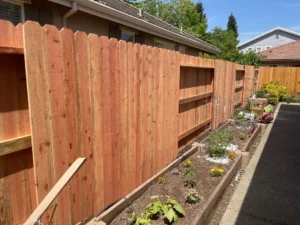
Dog ear refers to the shape of the picket tops—each board has the top corners trimmed at an angle, creating a subtle, classic look that’s clean and timeless. Good Neighbor style means the fence looks attractive from both sides, with the rails and posts tucked between the pickets rather than exposed on one side. This is especially important for rental properties where the neighbor’s side of the fence matters just as much as your tenant’s side—particularly when you’re splitting costs under the Good Neighbor Fence Law.
Why Redwood?
Redwood is a natural fit for rental property fencing for several reasons:
- Redwood is competitively priced and widely available in the Sacramento region, keeping material costs manageable across multiple properties.
- Natural durability. Redwood has a natural resistance to rot, insects, and decay, which means it holds up well over time—even without staining or sealing.
- Attractive appearance. Redwood’s warm, natural color gives the fence a clean, appealing look that enhances curb appeal and tenant satisfaction.
- Consistent availability. As the standard material for fencing in our area, redwood is always in stock and easy to source, which means your project won’t be delayed waiting for specialty materials.
Our #1 Recommendation: Hidden Steel Posts
If you plan to own the property for a while, go with hidden steel posts. A small price difference. A huge longevity difference.

This is the single most impactful recommendation we can make to any rental property owner or manager: choose hidden steel posts over standard pressure-treated wooden posts. Here’s why.
The Problem with Today’s Pressure-Treated Wood Posts
If you’ve been in the property business for a while, you probably remember the days when a pressure-treated fence post could stay in the ground for 20 or even 25 years without any issues. That wood was treated with a chemical called CCA (Chromated Copper Arsenate)—and it was incredibly effective at resisting rot and insects in ground contact. It lasted.
But CCA contained arsenic, and due to health and environmental concerns, it was phased out of residential use in January 2004. The replacement preservative—ACQ (Alkaline Copper Quaternary)—is safer for people and the environment, but the reality in the field is that ACQ-treated posts simply do not hold up as long as the old CCA posts did. The wood rots faster at the ground line, posts weaken sooner, and fences start leaning and failing years earlier than they used to.
On top of that, ACQ-treated lumber is significantly more corrosive to metal fasteners and hardware, which can accelerate deterioration at connection points. And much of today’s pressure-treated wood comes from fast-growth plantation lumber that just doesn’t have the density and durability of the old-growth timber that was common decades ago.
The Solution: Hidden Steel Posts
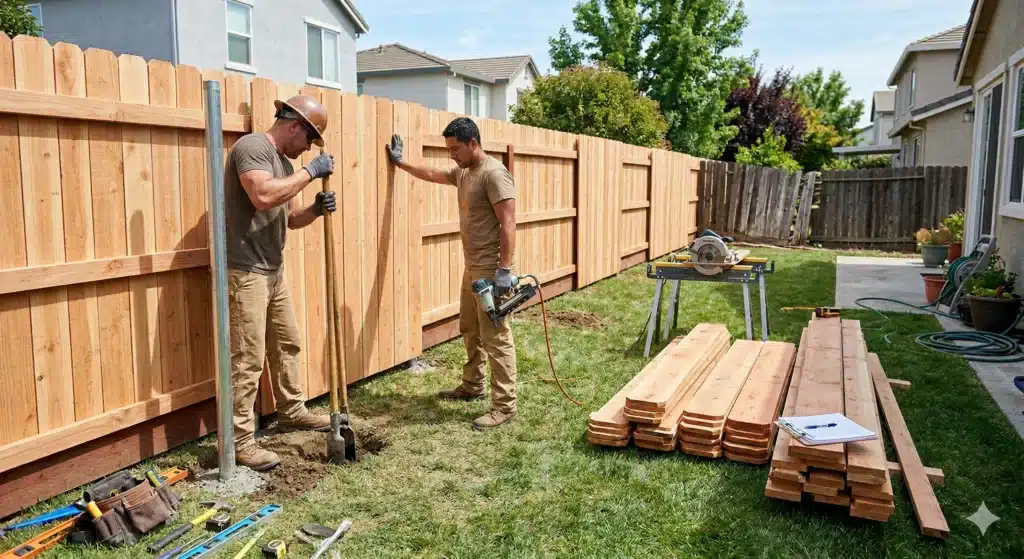
Hidden steel posts are galvanized steel posts that are set in the ground in place of traditional wooden posts. The wood pickets and rails attach to the steel, and once the fence is complete, the steel posts are completely hidden—you’d never know they were there from looking at the fence. The result is a fence that looks exactly like a traditional wood fence but has a structural backbone that will far outlast any wooden post in the ground.
Steel Posts vs. Pressure-Treated Wood Posts
Factor | Hidden Steel Posts | Pressure-Treated Wood |
Longevity | Decades—steel doesn’t rot | 10–15 years (ACQ era) |
Ground rot | Immune—galvanized steel | Vulnerable at the ground line |
Appearance | Completely hidden—looks like wood | Standard wood post look |
Cost difference | Small increase per post | Baseline cost |
Long-term value | Excellent—avoids full replacement | Moderate—posts fail first |
Our installs | ~85% of all jobs | ~15% of jobs |
Approximately 85% of our fence replacements and new installations now use hidden steel posts. The price difference is small, but the difference in how long your fence will last is enormous. For a rental property that you plan to hold for years—this is a no-brainer.
How We Make It Easy for Property Managers and Owners

We’ve worked with enough property management companies and rental property owners to know exactly what makes a fencing project frustrating—and we’ve built our process specifically to eliminate those pain points. Here’s what sets us apart:
Proposals with Photos
We know that property managers and off-site owners can’t always make it out to every property. That’s why every proposal we send includes detailed photos of the existing fence and property conditions. You’ll be able to see exactly what we’re seeing—the damage, the layout, the neighboring fences—without having to drive across town. This gives you the confidence to approve the work and keep things moving, even when your schedule won’t let you visit the site in person.
Neighbor Addresses Included for Shared Fences
Under California’s Good Neighbor Fence Law, you need to notify the adjoining property owner before building or repairing a shared boundary fence. That means you need their address. We include the neighbor’s addresses in our proposals for every shared fence so you have the information you need to send that required 30-day notice letter without having to research it yourself. One less thing on your plate.
Custom Door-Knock Letters for Management Companies
This one is a game-changer, and our property management customers absolutely love it. For our management company clients, we leave a custom letter on the neighbor’s door asking them to contact you directly about the shared fence project. This letter is professional, clear, and does the outreach work for you.
Why Property Managers Love This: Normally, when a shared fence needs work, your team has to research the neighbor’s address, draft a letter, print it, and either mail it or send someone out to deliver it—often for multiple properties at once. Our door-knock letter eliminates that step entirely. The neighbor gets a professional introduction to the project and a prompt to call you, which means fewer letters your team has to send and a faster path to getting the fence approved and built.
What to Look for When It’s Time to Replace or Install a Fence
Not sure if your rental property’s fence needs attention? Here are the most common signs that it’s time to act:
- Posts leaning or pulling away from the ground. This is almost always the first sign of failure, and it’s usually because the wooden posts have rotted at the base—the exact problem hidden steel posts eliminate.
- Boards that are cracked, warped, or falling off. Individual pickets and rails can be replaced, but if the damage is widespread, a full replacement is more cost-effective.
- Visible rot at the ground line. If you can push a screwdriver into the base of the post and it sinks in, the post is compromised.
- Fence sections that are sagging or bowing. This usually indicates structural failure at the post or rail level.
- Tenant complaints. If your tenants are telling you the fence is falling apart, it’s usually worse than you think. Get ahead of it before it becomes a bigger problem.
- Gaps at the bottom large enough for pets to escape. This is a common source of tenant frustration and can lead to turnover.
Cost Considerations for Rental Property Fencing

We understand that as a property manager or rental property owner, you’re watching your budget closely. Here are some things to keep in mind when evaluating fencing costs:
- Shared fence costs can be split. Under California’s Good Neighbor Fence Law, the neighboring property owner is presumed to share half the cost of a boundary fence. This can significantly reduce your out-of-pocket expense.
- The cheapest option isn’t always the smartest. A fence built with standard pressure-treated posts might save a small amount upfront, but if those posts rot in 8 to 10 years and you’re replacing the entire fence again, the true cost is much higher. Hidden steel posts add a small amount to the initial price but save you from a full replacement down the road.
- Fencing is a depreciable asset. The IRS allows rental property owners to depreciate fencing over 15 years as a land improvement. That means you can deduct a portion of the cost each year on your taxes. Talk to your accountant about how this applies to your situation.
- Material costs are rising. Like everything else in construction, fencing materials have gotten more expensive in recent years. Locking in your fence project now avoids paying even more later.
Proudly Serving Property Managers Across the Region
We work with property management companies and individual rental property owners throughout the greater Sacramento area. Our most active service cities for property management fencing include:
Sacramento | Elk Grove | West Sacramento |
Natomas | Roseville | Lincoln |
Whether you have one property that needs a fence or twenty, we’re set up to handle the volume and keep the process smooth for your team.
You’re Busy. We Make Fences Easy.
We built our process around property managers and rental property owners because we know how demanding your job is. From photo-documented proposals to neighbor address research to custom door-knock letters, every step is designed to save you time and reduce the back-and-forth.
Here’s what working with us looks like:
✔ We visit the property and assess the fence
✔ You receive a proposal with photos, neighbor addresses, and clear pricing
✔ For management companies, we leave a door-knock letter on the neighbor’s door
✔ We build the fence with hidden steel posts and quality redwood materials
✔ You get a fence that lasts—and a process that respects your time
Contact us today for a free estimate.
Let’s talk about your properties. We’ll take it from here.
You’re busy. We make fences easy.