Key Takeaway
Chicken wire fencing is designed to contain small animals like chicks and rabbits, not to stop predators. Raccoons can reach through its openings, coyotes can tear through the thin 20-gauge wire, and diggers slip under it overnight. For real protection, hardware cloth with openings under 1 inch, buried at least 12 inches deep, is the standard upgrade most backyard coops actually need.
Chicken wire, also called poultry netting or hex netting, is a thin, flexible woven mesh built to confine small, light animals in small spaces and to close small gaps. It is one of the least expensive fencing materials you can buy, and it’s easy to cut and shape. What it isn’t: a perimeter fence, and not a predator barrier. If you’re deciding whether chicken wire is right for a chicken coop, a garden bed, or a fence project, that distinction is the whole ballgame. Here’s the catch we run into all the time: most people who ask for chicken wire actually need a different material entirely. They want to protect their chickens, and chicken wire keeps chickens in far better than it keeps predators out.
Not sure which wire fence you need? Call (916) 790-7100 for a free estimate, and we’ll tell you straight.
First, What Do People Actually Mean by “Chicken Wire”?

When a customer says “chicken wire,” we always ask what they’re trying to do. Nine times out of ten, the answer points to a completely different product.
Actual chicken wire is properly called poultry netting or hex netting. It’s thin galvanized wire woven into hexagonal openings, usually 1/2 inch to 2 inches across. Most retail rolls run 20 gauge, with the common range sitting between 19 and 22. Heavier 16- and 18-gauge hex netting exists, but it’s special-order, not what’s stacked on the shelf. The material is lightweight, cheap, and easy to cut. It bends around trees, posts, and odd corners without a fight. Those are genuine virtues in the right job.
But it offers no structural rigidity. It won’t hold tension, it collapses under pressure, and it won’t stop anything strong enough to lean into it. On top of that, if the galvanized coating gets nicked during install, the exposed wire can start to rust. So if you actually want a fence, you want a different material.
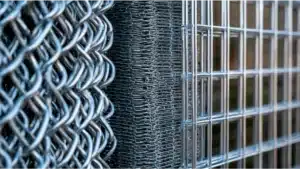
This is where the confusion costs people money. Welded wire, hardware cloth, field fence, and chain link fencing all get lumped under the “chicken wire” label, and each one behaves completely differently. Buying the wrong roll of wire mesh for the job is the number one mistake we see. People lose birds to predators because they trusted the wrong material, then buy the right one a second time. Sorting out the terminology first saves you a return trip to the store and a second attempt at the project.
Chicken Wire vs. Hardware Cloth, Welded Wire, Field Fence, and Chain Link: Quick Comparison
Once you separate these five materials, the right choice usually becomes obvious. Here’s how they stack up.
| Material | What it looks like | Typical mesh | Typical gauge | Holds tension? | Stops small animals | Stops large predators | Best use |
|---|---|---|---|---|---|---|---|
| Hex chicken wire | Hexagonal openings, twisted joints | 1/2″ to 2″ hex | Usually 20 (thin) | No | Yes, its main strength | No | Small enclosures, closing gaps |
| Hardware cloth | Welded square grid | 1/4″ to 1/2″ | Around 19 | Somewhat | Yes, plus rodents | Better | Coops, small-animal exclusion |
| Welded wire | Square grid, welded joints | Commonly 2″ x 4″ | 12.5 to 14 | No, strength is rigidity | Only if gaps are small enough | Better | Gardens, animal pens |
| Woven / field fence | Rectangular grid, knotted joints | Graduated, tighter at bottom | 12.5 | Yes, designed for it | Bottom only | Better | Acreage, livestock, ag |
| Chain link | Diamond pattern, interlocking | 2″ to 2-1/4″ diamond | 11 to 11.5 residential, 9 commercial | Yes | Only larger ones | Better | Perimeter, security, dog runs |
The single most useful takeaway: most welded wire comes in 2″ x 4″ mesh, and non-graduated woven wire leaves openings at least that large right at ground level. That’s a big enough gap for a small animal to slip through and for a predator to reach a paw through. Closing gaps smaller than that is chicken wire’s entire reason for existing. Hardware cloth deserves a note too, since it’s the one people confuse most with chicken wire. It’s thick steel wires welded into a small square grid, far stronger, and it lasts up to 20 years when it’s coated and installed well. If you want one wire mesh that actually protects chickens, hardware cloth is usually it.
What Chicken Wire Is Actually Good For

Used for what it’s actually good at, chicken wire works well. Here’s where we see it earn its place.
- Containing very small animals. Chicks, bantams, rabbits, ducks, and small turkeys will walk straight through a 2″ x 4″ opening. Hex netting with 1/2″ or 1″ holes won’t let them. Nothing does this more cheaply.
- Closing the bottom gap on non-graduated wire fencing. This is the application we install most often. Field fence with graduated spacing is woven tighter at the bottom on purpose. A lot of wire fencing isn’t graduated, and uniform 2″ x 4″ mesh leaves a ground-level gap that chicken wire closes cheaply.
- Light garden protection. The open weave gives you visibility and airflow around beds while keeping light animals and birds out of your vegetables.
- Temporary barriers. Separating birds inside a flock or cordoning off a garden zone for a season is a fine job for a roll of hex netting.
- Upper sections of a chicken run. When the lower half is protected with hardware cloth, chicken wire can handle the upper walls to keep birds in and flying predators like hawks out, provided the run is fully covered on top.
Its ability to bend around trees, posts, and odd structures also makes it handy for one-off shapes where a rigid panel would be a pain to work with. For a weekend project where you’re putting up a quick barrier around a raised bed, it’s hard to beat on cost.
Where Chicken Wire Fails, and Why Predators Get Through
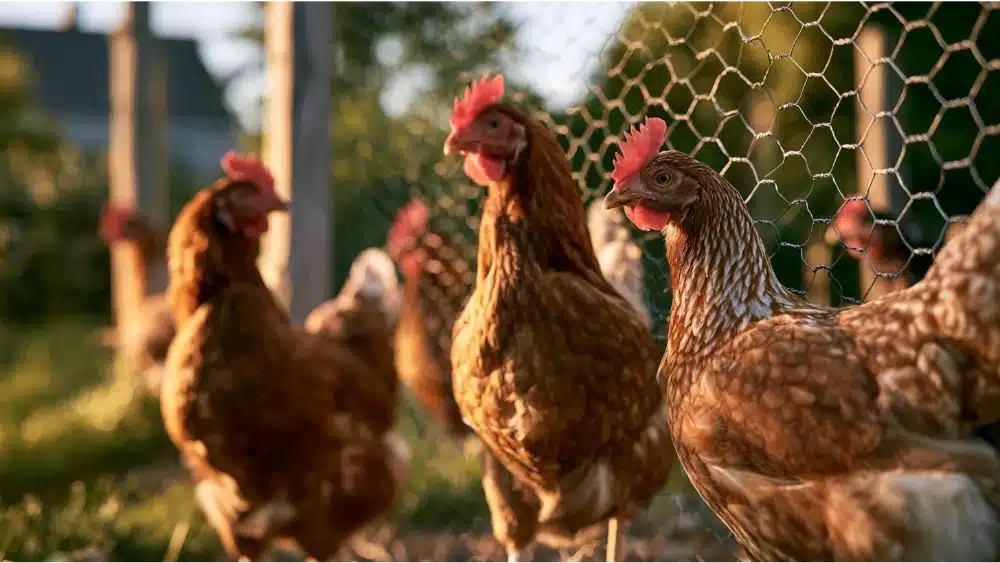
Chicken wire keeps chickens in. It does not reliably keep predators out. That’s the line extension programs like UC Agriculture and Natural Resources come back to again and again, and it matches what we see in the field.
The failure modes are predictable. The openings are large enough that a raccoon can reach a paw through and grab. The thin wire bends and tears when a coyote or a determined dog leans into it. A hungry fox or raccoon will dig under the bottom edge overnight, which is when most losses happen, because raccoons, foxes, and coyotes hunt at night. Aerial predators like hawks and owls, along with climbing critters, come over the top of an uncovered run. Snakes slip through the holes to reach eggs and chicks. Under real pressure, light poultry netting just doesn’t hold, and by morning the flock is lost. A predator can kill an entire flock in a single night once it gets inside.
Extension guidance is consistent on what actually protects chickens. Use wire openings smaller than 1 inch so predators can’t reach through. Put hardware cloth on the vulnerable lower half of a coop or run, since that’s where ground predators like raccoons reach and dig. Bury hardware cloth at least 12 inches into the ground, with some sources recommending 1 to 2 feet or an outward-facing apron a foot or more wide to stop diggers. Keep the run covered against animals that come from above or climb in. For roaming ground predators, an electric poultry netting or electric fence works as a movable deterrent you can reposition as needed.
Chicken wire’s shortcomings aren’t limited to coops. Don’t use it for dog fencing, long perimeter runs, livestock or acreage boundaries, gates and high-use openings, privacy, or security. And it is never a pool safety fence. For every one of those jobs, there’s a material built to do it right.
Better Alternatives to Chicken Wire: Match the Material to the Job
The cleanest way to choose is to start from your goal, then pick the wire.
- Predator proof chicken coop: use hardware cloth, 1/4″ to 1/2″ mesh, on the lower walls, vents, doors, and a buried edge. This is the closest most backyard setups get to keeping a flock truly fairly safe from predators.
- Garden fencing: welded wire, with a small-mesh bottom layer if you’re also fighting rabbits or rodents.
- Small animals and rodents: hardware cloth or a smaller-mesh welded wire.
- Dog runs: chain link fencing, or properly framed welded wire panels. Dogs bend, chew, and push through light netting.
- Livestock and acreage: woven field fence, which holds tension over long runs and is built for larger animals, sometimes with an electric fence offset.
- Perimeter security: chain link fencing, ornamental iron, or Durabond steel for heavy-duty, long-term protection.
- Privacy: wood, vinyl, or steel. Never chicken wire.
- Pools: an approved pool safety fence, full stop.
Durability is worth a word here. Bare galvanized wire can rust once the coating is damaged, so vinyl-coated or PVC coated wire resists rust and adds years to the life of the fence. PVC coated hardware cloth is a good choice for a coop that has to stand up to wet Sacramento-area winters. Plastic poultry mesh is UV-resistant and won’t rust at all, but it offers no predator resistance, so keep it to light garden and containment work. When you shop for wire, pull the mesh super tight against its frame; a loose panel is easy for an animal to work loose.
These are the projects we build every day. Fantastic Fence installs chain link fencing, agricultural fencing, ornamental iron, Durabond steel, wood and vinyl fences, gates and gate openers, and pool safety fencing. We’re licensed, bonded, and insured under CSLB License #979657, our crews are background-checked W-2 employees, and we quote with flat pricing and zero hidden fees. When the job calls for a real fence, we’d rather help you get the right material the first time than watch you pay twice.
How to Choose, Plus the Install Details That Matter More Than the Roll

Before you buy anything, run through these questions:
- Are you keeping animals in, predators out, or both?
- How small is the animal, and are you protecting chickens or other breeds of poultry specifically?
- Will anything push, climb, chew, or dig?
- Is this temporary or permanent?
- Does it need to meet code, HOA rules, or pool safety requirements?
- Do you need a gate?
- Will posts be dug, and has 811 been called?
Once you’ve picked the wire, the install decides whether it holds. A few things matter more than the roll itself. Chicken wire has no strength of its own, so it needs a support frame and solid posts or it sags and collapses. Set each post deep and firm, because a wobbly post makes the whole run easy for a predator to work loose. Fasteners have to be tight and close together, or animals work the mesh loose at the staples. Seams and overlaps are common weak points, so lap them well and secure both edges. When you close the bottom gap, use buried hardware cloth or an outward-facing apron so a fox or bear digging at the base hits wire instead of soil. On a chicken run, add a top cover so nothing drops in at night. And gate latches deserve real attention, since a latch a raccoon can flip is no latch at all.
Buried Hardware Cloth, Electric Fence, and the Layers That Keep a Flock Safe
No single material makes a coop bulletproof, so the goal is layers that work together to help your flock stay safe. Line the lower walls with hardware cloth, bury an apron of hardware cloth at the base against diggers, cover the top against aerial predators, and add an electric fence offset for roaming ground animals. Together those layers turn a vulnerable pen into something that keeps your pets and livestock secure through the night. It costs a little more up front than a plain roll of hex netting, but it saves you the far higher cost of a lost flock.
One California safety step applies to any project where you’re setting posts: call 811 at least two working days before you dig. PG&E and Underground Service Alert list fence posts as a project that needs utility marking, and a licensed C-13 fence contractor pulls its own dig ticket before breaking ground.
A Note for Elk Grove and Sacramento-Area Property Owners
Chicken wire is perfectly fine for small backyard jobs around here: a coop, a couple of raised beds, closing a gap on fencing you already have. Where you want to slow down is anything permanent. Fences, gates, agricultural fencing, chain link dog runs, and pool safety fences should be planned around local code, soil, layout, and how you’ll actually use them. If your enclosed run backs up to neighbors or open land where predators travel, that layout matters even more. Elk Grove’s fence-height rules run roughly 3 feet in front yards and up to 7 feet in interior side and rear yards, with tighter limits in clear-visibility areas, and pool safety fencing is regulated separately. Rules change, so check current local code before you commit to a design. Our Elk Grove office at 9245 Laguna Springs Dr, Suite #228 handles exactly this kind of planning, and we know the area’s yards and ordinances.