
Key Takeaway
A safe horse fence stands at least 5 feet tall, uses woven wire mesh with 2-by-4-inch openings to prevent hoof entrapment, and includes a visible top rail so horses can see the barrier at a gallop. Board fences and horse-rated steel panels are strong alternatives for high-pressure areas like corrals. Barbed wire and standard cattle field fence should never be used around horses. The right fence type depends on whether you are fencing a perimeter, pasture, paddock, or corral.
Last updated: September 2026
For most horse properties, the safest permanent horse fence is a highly visible, smooth, strong barrier standing about 5 feet tall. In practice that usually means a horse-safe woven wire fence with small 2-by-4-inch mesh openings topped by a visible rail, or a well-built board fence. Skip barbed wire, and skip any design with openings large enough to trap a hoof or a head. Beyond that, the right answer depends on what the fence is doing: a road-facing perimeter fence and a corral for a pushy stallion are two different problems.
This guide is written for horse owners planning a perimeter, pasture, paddock, or corral, and for anyone about to hire an installer and wondering what questions to ask. You’ll get a decision process organized by application, real specifications from university extension sources, an honest comparison of the fence materials worth considering, and a short section on what to verify with your local jurisdiction. We install fencing across the Sacramento region for horse farms, agricultural properties, and large acreage, so some of this comes from the field as well as the literature.
What Makes a Horse Fence Safe?

Safe horse fencing has to solve equine containment and injury prevention at the same time. The fence materials matter, but so do height, opening size, bracing, gates, fence posts, and how cleanly the whole thing is assembled. A horse that hits a fence at speed does not care what the brochure said.
It helps to understand why horses get hurt on fencing that cattle live with for decades. Horse hides are thin and tear easily, horses flee first and think second, and a trapped leg triggers a fight response rather than a pause. Wire that a steer would shoulder past will open a horse hide down to the tendon. An equestrian fence has a harder job than a cattle fence for that reason alone, and that single difference drives nearly every recommendation in this guide.
Visibility a running horse can actually see
Horses have excellent peripheral vision and comparatively poor focus straight ahead, which is exactly the wrong combination when they’re galloping toward a fence line. Thin, smooth wire can be nearly invisible to a horse in motion. That’s why extension guidance keeps returning to visibility: a sight board, a coated rail, or a wide visible tape gives the horse something to read at distance and slow down for. It’s also the cheapest safety upgrade on the list, because one top rail turns a nearly invisible wire fence into a horse fence a galloping animal will respect.
Strong enough to contain, forgiving enough on impact
You want a barrier that holds a 1,100-pound animal leaning on it and still gives a little when that animal hits it hard. Rigid and unyielding can break bones. Loose and flimsy lets horses walk through. A woven wire fence under proper tension, flexible polymer rail, and well-fastened boards all sit in that useful middle: they resist steady pressure and absorb some energy in a wreck. That balance is the entire idea behind safe horse fencing. The fence should stop the horse without becoming the thing that injures him, and fence failure and injury usually show up in the same incident.
No openings, edges, or projections that catch a hoof
Most horse fence injuries we hear about are entrapment or laceration, not escape. A hoof caught in an oversized opening turns a barrier into a trap in about two seconds. To prevent injury, openings need to be small enough that a hoof, shoe, or head can’t pass through and lock. Nail heads, screw points, cut wire ends, and jagged board breaks all need to be removed or turned away from the horse side. As the University of Minnesota Extension and other equine sources put it plainly, barbed wire has no place in a horse enclosure, and a single strand of bare smooth high tensile wire on its own is close behind it.
Best Horse Fence Types by Application: Perimeter, Pasture, Paddock, and Corral
Decide what the fence is doing before you decide what it’s made of. A half-mile boundary along a county road has a different job than a 60-foot dry lot where two geldings crowd the gate at feeding time. A pasture fence carries low, steady pressure across long runs; a corral takes constant contact in a small space. Containment pressure, the consequence of a failure, and how often you’ll be out there maintaining it all shift the answer, and most horse farms end up using two or three different fence styles in different places.
| Enclosure role | Containment pressure | Best-fit fence types | What to prioritize |
|---|---|---|---|
| Road-facing perimeter fence | Low pressure, catastrophic consequence | Horse-safe woven wire fence with a top sight rail; board fence; combination systems | Full 5-foot height, no gaps at grade, strong corners, secure gates |
| Interior pasture fence | Low to moderate | Woven wire fence with sight board; flexible polymer rail; board fence | Visibility, long-run bracing, easy inspection access |
| Paddock or dry lot | Moderate to high | Woven wire fence; horse-rated vinyl rail; steel pipe or panels | Height at or above eye level, small openings, no trapping corners |
| Corral or high-pressure pen | High, constant contact | Steel pipe, horse-rated panels, heavy welded steel | Physical strength, smooth surfaces, zero projections |
| Interior cross-fence | Low to moderate | Woven wire fence; polymer rail; visible electric fencing with a permanent perimeter behind it | Visibility, ability to reconfigure, no nose-to-nose pinch points |
| Temporary rotational grazing divider | Low, managed | Visible electric tape or coated wire on step-in posts | Only inside an existing permanent perimeter; daily voltage checks |
That last row matters. The University of Minnesota Extension describes temporary fencing as an interior dividing option within a permanent enclosure, not a boundary in its own right. If the electric fencing loses power at 2 a.m., something solid still needs to stand between your horses and the road. If you’re fencing acreage, our agricultural fencing work is built around that layered approach: a permanent perimeter fence first, then whatever interior divisions your grazing plan needs.
Horse Fencing Options Compared: What Works Best on Real Horse Farms
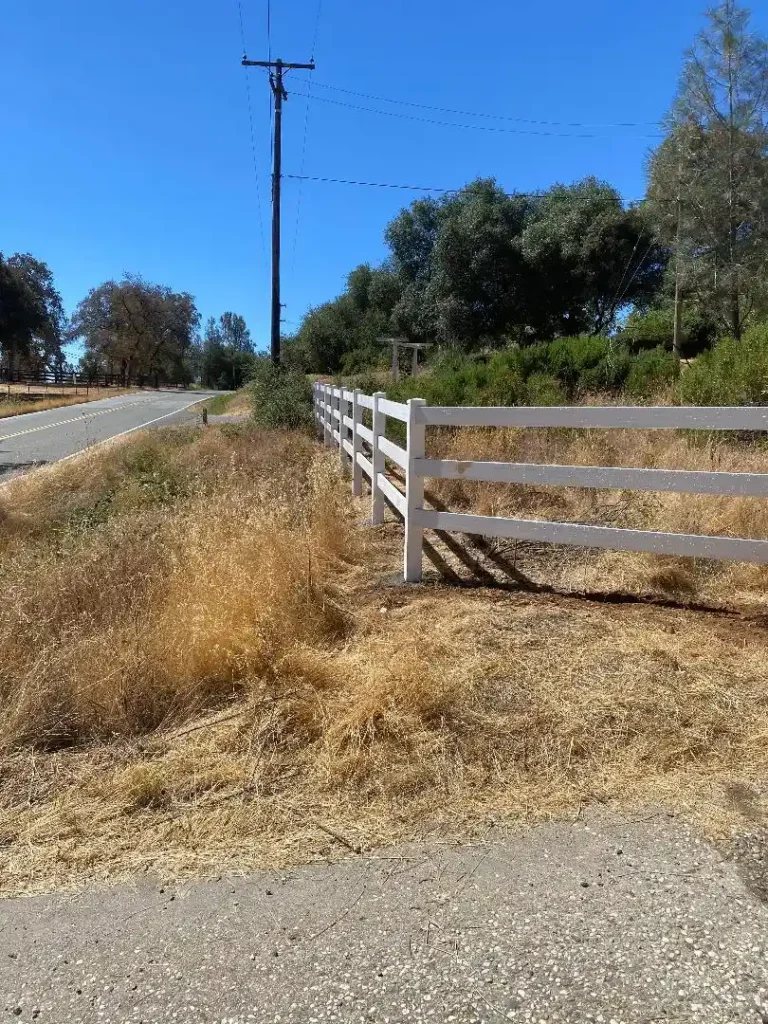
There is no single best material for every horse property. Every one of these fencing options trades visibility, physical containment, maintenance load, and affordability against the others, and the honest answer usually involves combining two. Compare fence materials on those four axes rather than on looks alone, then check the fifth one nobody thinks about until year six: what it costs you in time.
| Material | Visibility | Physical containment | Maintenance | Best uses |
|---|---|---|---|---|
| Horse-safe woven wire mesh | Low on its own, good with a top rail | Excellent | Low to moderate (tension, weeds) | Perimeter, pasture, paddock |
| Wood board fence | Excellent | Good | High (paint, fasteners, replacement) | Perimeter, pasture, frontage |
| Vinyl / PVC rail (horse-rated) | Excellent | Moderate | Low | Pasture, paddock, visible frontage |
| Flexible polymer rail | Excellent | Good | Moderate (tension checks) | Pasture, cross-fencing, long runs |
| Coated horizontal cable | Moderate, better with a top rail | Good | Moderate (tension, hardware) | Long runs, gentle stock, view-sensitive lines |
| Steel pipe and horse-rated panels | Good | Highest | Very low | Corrals, stallion pens, high-traffic areas |
| Visible electric fencing (tape or coated wire) | Moderate to good if wide and coated | Psychological only | High (voltage, vegetation, grounding) | Offsets, temporary cross-fencing |
| Barbed wire / standard field fence | Poor | Fair for cattle | Moderate | Not recommended around horses |
Horse-safe woven wire fence (no-climb wire mesh)
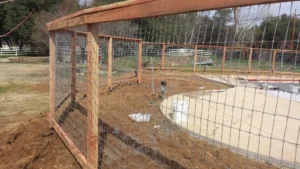
A woven horse mesh fence gives you the most reliable physical barrier per dollar, which is why it shows up on so many working horse farms. The 2-by-4-inch openings are too small for a hoof to pass through and lock, and the tightly woven knots hold their shape under pressure instead of popping. The manufacturing matters as much as the grid: in true woven mesh, machines are weaving wire around every intersection so the vertical wires and the horizontal wires lock together and still flex. At each crossing the wire knot hugs the two wires and holds the horizontal wires tightly in place, which is what keeps the grid from sliding out of square when a horse leans into it. University of Georgia Extension recommends a minimum 12.5-gauge wire for standard mesh unless you’re using high tensile steel, and specifically warns that inexpensive welded utility mesh often fails at the joints in field conditions.
Its one real weakness is visibility. A bare wire mesh fence reads as empty space to a horse at a gallop, so add a top board, a coated rail, or a visible sight wire. That top element does double duty: it gives horses something to see, and it keeps them from draping their necks over the mesh and stretching the top course out of shape.
Wood board fence (plank fence)
Nothing reads as clearly to a horse as a board fence, and nothing looks more like a horse property from the road. Wood fencing is affordable, classic, and presents far fewer hoof-entrapment points than conventional farm wire. Most builds use pressure-treated wood posts with 1-by-6 or 2-by-6 rails, and the rails are where your money goes on a long run.
The tradeoff is upkeep. Horses chew it, lean on it, and pop fasteners loose, and a snapped board leaves splintered wood rails exactly at chest height. Wooden posts also do their rotting right at the grade line, where you can’t see it, so a post that looks fine can snap off at ground level when a horse leans on it. Plan on a real maintenance rhythm: paint or stain, tighten hardware, probe suspect wooden posts at the base, and replace broken boards before a horse finds the jagged end. An electric offset inside the line cuts chewing and rubbing dramatically.
Vinyl and PVC rail fence
Vinyl gives you board-fence visibility without the painting, and its weather resistance holds up well through hot inland summers. It also doesn’t splinter the way natural wood does when it breaks, which is a genuine horse safety point. Vinyl coated wood rails show up on some properties too, and the coating cuts painting and chewing, though the wood underneath still needs the same inspection at the grade line. The caution is specification: a decorative residential vinyl fence is not a horse fence. You want a purpose-built, horse-rated rail system with reinforcement designed for livestock pressure. Ask about the internal reinforcement and the bracket design, not just the color, and expect to replace individual rails occasionally rather than repair them.
Flexible polymer rail, horizontal cable, and high tensile wire systems
Flexible polymer rail is one of the better compromises available: it looks like a board fence from a distance, and it carries high tensile wire inside the rail for strength. Impact-absorbing horse mesh systems designed to flex rather than cut work on the same principle. Coated horizontal cable belongs in the same family, and twisted horizontal cables under proper tension are worth considering where owners want containment without blocking a view, as long as a top rail or sight board makes the line visible.
All of these depend entirely on correct bracing and tension. High tensile wire only performs at the tension it was designed for, which means in-line tensioners, spring compensators for temperature swings, and end assemblies built to take the load. Under-braced corners let the whole run go slack, and a slack polymer rail or loose wires sag into exactly the shape a horse can get a leg over. Budget for periodic tension checks on any high tensile system. What you should never do is run bare single-strand smooth high tensile wire as a standalone horse fence, because it’s close to invisible and it cuts.
Steel pipe, Durabond steel, and horse-rated panels
When a horse is going to be in constant contact with the fence, steel wins. Pipe corrals, welded steel panels, and Durabond steel systems give you the highest containment available with smooth surfaces and no projections, and they shrug off years of leaning, cribbing, and weather with almost no maintenance. The tradeoffs are real: steel costs more up front and gives very little on impact, so it’s better suited to corrals, stallion pens, gate aprons, and high-traffic feeding areas than to a mile of open pasture where a horse might hit it running.
Electric fencing as a tool, not a whole fence
Electric fencing works well once horses learn to respect it, and it’s an excellent offset for stopping leaning, chewing, and fence-line fighting. Use wide coated wire or tape rather than thin bare electric fence wire so a running horse can see it. The system side deserves attention: energizer sizing, a proper grounding system, and vegetation control off the line all determine whether you have working electric fencing or a decorative one. In inland Northern California, dry-season soil conductivity can quietly drop the effectiveness of systems that rely on ground return, so test voltage regularly and follow the manufacturer’s grounding instructions for your soil. Treat it as a psychological barrier layered onto a physical fence, never as the physical fence itself.
Why barbed wire and standard field fence don’t belong around horses
Barbed wire cuts. A horse that panics in it does not back out calmly, and because horse hides tear so readily, the injuries are often severe. Traditional wire field fence built for cattle is nearly as bad in a different way: the lower openings in that style of wire fence are large enough for a leg to slide through and catch, which is why both materials fail the animal safety test on a horse property. University extension guidance across multiple states is consistent on this point. Here’s the distinction worth holding onto, because it comes up again below: a material can be perfectly legal in an agricultural zone and still be a poor choice anywhere a horse can reach it. Permitted and horse-safe are two separate tests.
How Tall Should a Horse Fence Be? Height, Mesh, and Spacing Specs
Most horse fences run 48 to 60 inches, and 5 feet (60 inches) is the commonly recommended minimum for perimeter fencing, according to University of Georgia Extension. Interior dividing fences are often built at 4.5 to 5 feet. For paddocks, corrals, stallion pens, and horses you already know will try it, UGA offers a better rule than a flat number: set the top of the fence at roughly eye level, about 4 to 6 inches above the withers.
One thing that catches people out is that height is measured from the ground the horse is standing on, not the ground you set the post in. A drainage swale, a fill pad, years of erosion along a fence line, or a horse standing on a manure pile all cut your effective height. Walk the line and look at the low spots.
Bottom clearance and the space between rails
For mesh and dividing fences, UGA suggests leaving roughly 6 to 8 inches between the bottom of the fence and grade. Keeping the bottom wire up off the dirt discourages pawing, makes vegetation control easier, and adds a few inches of usable height. Penn State Extension recommends keeping open spaces between non-electric rails or line wires to 12 inches or less, and limiting bottom clearance to no more than 12 inches where a foal could roll or scoot underneath. On uneven terrain, tighten both figures.
Mesh size, wire gauge, and why the grid pattern matters
The 2-by-4-inch opening is the specification to remember. Square-knot horse mesh is often cited at 2 to 4 inches of horizontal spacing, and UGA calls for at least 12.5-gauge wire unless high tensile steel is used. The manufacturing method is as important as the grid. Weaving wire together at each joint, whether by knot or by wrap, produces a connection that flexes under load and returns to shape, and that flex is a big part of how a woven wire fence helps prevent injury. Welded utility mesh has rigid joints that crack under a horse’s weight, then unravel until you have a hole. Fence manufacturers publish knot type, gauge, and galvanizing class for their products, and those numbers tell you more than the price per roll does. Galvanizing class matters if you want the mesh to outlive the posts.
Fence Posts, Post Spacing, and the Rest of the Fence Line: The Parts That Fail First
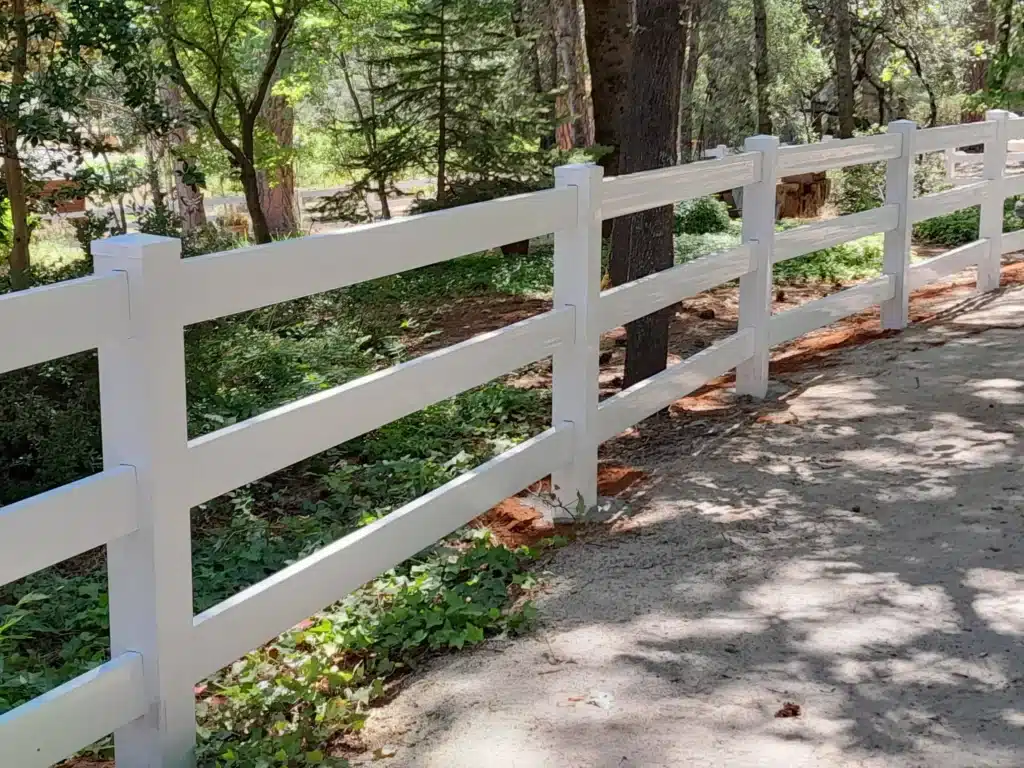
Post spacing is where a lot of well-intentioned projects go sideways. General planning ranges from UGA look like this:
- 8 to 10 feet for rail fences
- 10 to 12 feet for many conventional fence systems
- Up to about 25 feet for certain properly braced high tensile systems
Treat those as planning references, not specifications. Actual spacing, embedment depth, and wire gauge depend on the fence materials and manufacturer’s requirements, soil type, terrain, how much animal pressure the line takes, wind exposure, and where your corners and gates land. Sandy soil and clay behave nothing alike when a horse leans on a line post for three years.
Fence lines rarely fail in the middle of a straight run. Fence failure happens at corners, ends, and gate posts, because that’s where all the accumulated tension goes. A high tensile or woven wire fence pulling against an under-built corner will lever that post out of the ground slowly, and then the whole run goes slack. Proper construction of corner and brace assemblies is not an upgrade, it’s the thing holding the fence up.
Material choice for fence posts is its own decision. Pressure-treated wood posts rated for ground contact are the default on most horse farms because they take fasteners, look right under a board or mesh fence, and hold up well when they’re set deep enough and drained properly. Steel t posts are cheaper and faster to drive, and they’re fine as line posts in some pasture applications, but only with caps installed. An uncapped t post at chest height is a spike, and t posts have impaled horses that hit them running. They also bend and stay bent, so any run of t posts needs a real inspection habit. Where you want the strength of steel without the look of it, our Bolt-Up Hidden Steel Posts put the structure inside the fence line and keep the visible surface clean.
Gates and Access: Widths, Latches, and Trapping Points
Gates take more abuse than any other part of a horse fence, because that’s where horses gather and where every tractor, mower, and wheelbarrow passes through. Plan widths around the equipment, not just the horse. UGA’s figures:
- 4 feet: minimum for a horse-only walk-through gate
- 8 feet: better minimum wherever equipment needs to pass
- 14 to 16 feet: main pasture gates that take a tractor, mower, wagon, or trailer
A horse gate should sit roughly level with the top of the surrounding fence, latch positively, and carry no sharp projections or pinch points anywhere a horse can reach.
Where to put a gate (and where not to)
Keep gates out of low ground. Standing water and churned mud at a gateway make a mess of the swing, the footing, and your horses’ feet. Avoid narrow dead ends and tight corners where a dominant horse can pin a subordinate one against the fence. Think through trailer turning radius and emergency access too: if a vet or a fire crew needs to get a vehicle to your barn, the gate has to be wide enough and reachable. For driveway entrances, an automatic gate installation with a properly sized gate opener saves a lot of climbing in and out of the truck in the rain.
Latches, gaps, and backup closures
Horses are good with their lips, and a clever one will work a simple slide latch open in a week. Use a horse-proof latch, then add a secondary chain or snap as backup on any gate that opens toward a road. Watch the gap between the gate edge and the post as well: wide enough for a hoof or a head is wide enough for trouble.
Installation Details That Decide Whether a Horse Fence Is Safe

The same fence materials can be safe or dangerous depending on how they’re built, and proper installation is what separates the two. These are the details that matter:
- Mount boards and mesh on the horse side of the fence posts. Penn State Extension makes this point clearly: when a horse pushes against the fence, its weight presses the material into the post instead of relying on fasteners to resist the pull. Keep the smooth side facing the horse.
- Eliminate every sharp thing. No protruding nail heads, no screw points coming through the far side, no cut wire ends left loose, no uncapped t posts. Wire ends get securely wrapped and tucked.
- Get tension and bracing right. Under-tensioned mesh sags into a shape horses can get legs over. Over-tensioned mesh pulls corners out of the ground.
- Stretch and hang wire mesh from the bottom up. Working upward keeps the bottom edge tight to grade, which is where escapes and entrapments actually happen.
- Follow grade changes. Step or rack the fence to match the ground so your 60 inches stays 60 inches across dips and rises.
- Install electric fencing offsets as a real system. Visible conductor, correct energizer, proper grounding, vegetation kept clear.
One more, and it matters more on horse properties than almost anywhere else: call 811 before digging. California requires notification to the regional notification center at least two working days before excavation, and Cal/OSHA requires the excavator to get responses on affected underground installations before work starts. Fence post holes count as excavation. A perimeter fence can mean hundreds of holes across ground with irrigation lines, well feeds, septic laterals, and buried electrical running through it. We call it in on every job, because guessing is how somebody ends up with an auger through a water main.
Matching the Horse Fence to the Horse: Foals, Minis, Stallions, and Jumpers
The same pasture can need a different fence depending on who’s standing in it. Adjust for the animal:
- Foals: tighten bottom clearance so a sleeping foal can’t roll under, and keep openings small. A foal will fit through a gap you’d never think twice about.
- Miniature horses and ponies: mesh rather than widely spaced rails, with a low bottom gap. Small horses go under, not over.
- Stallions: more height, heavier fence materials, and a real buffer between adjoining turnouts. Double fencing with an alley between is the standard answer for a reason.
- Jumpers and leaners: set the top at eye level or above, add an electric offset, and use steel posts where the pressure concentrates.
- Chewers and rubbers: an offset wire fixes most of it. Where the habit is entrenched, vinyl or steel holds up better than wood rails.
And think about neighbors within the herd. Two horses turned out in adjoining paddocks sharing one fence line will eventually fight across it, and legs go through wire during those arguments. A double fence or a wider buffer between paddocks is cheaper than a tendon, and it’s one of the simplest ways to protect horses from each other.
Horse Fence Rules in Elk Grove and Sacramento County
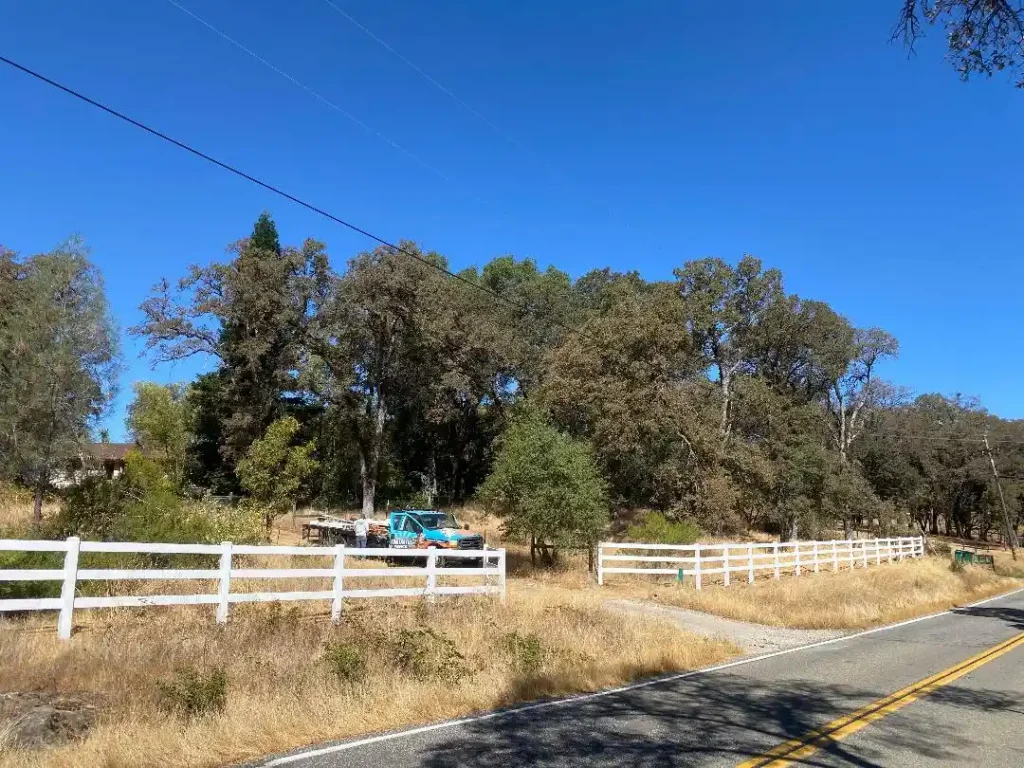
Before you measure anything, find out which jurisdiction you’re actually in. Properties with an Elk Grove mailing address aren’t always inside Elk Grove city limits, and the City directs owners to confirm jurisdiction before applying for permits. The rules differ between the city and unincorporated Sacramento County, so this is the first phone call, not the last.
Elk Grove agricultural and agricultural-residential fence heights
Within Elk Grove’s agricultural and agricultural-residential zoning districts, the Municipal Code generally allows qualifying open-view fencing up to 6 feet within a required yard, and up to 10 feet outside a required yard provided the fence is set back from interior property lines by at least its own height. Fences that exceed the applicable standards require minor design review. No special planning permit is generally needed for a compliant fence, though zoning clearance or plan check applies where a building permit is required.
Unincorporated Sacramento County horse enclosure rules
The Sacramento County Zoning Code requires horse corrals, riding rings, and exercise yards to be enclosed. The enclosure must sit at least 20 feet from a door, window, or other opening in a building intended for human habitation, and livestock fences must be adequate to contain the animals and keep them from crossing property lines or damaging adjacent property. That last clause is broad on purpose: containment is the standard, and a fence horses routinely get through isn’t compliant regardless of what it’s made of.
Permitted is not the same as horse-safe. Barbed wire, for example, is allowed in certain agricultural, open-space, and industrial contexts under specified conditions, with minor design review where it abuts residential or commercial areas, and equine authorities still advise against it anywhere a horse can reach it. Local code governs height and placement; horse safety concerns govern the rest. Codes are also amended regularly, so confirm your zoning district, HOA architectural guidelines and CC&Rs, easements, and any sight-distance rules with the city or county before you build. Our Fence Ordinance Quick Links are a reasonable starting point for finding the right department.
Horse Fence Inspection and Maintenance: A Checklist for Horse Farms
The USDA NRCS Fence Conservation Practice Standard 382 calls for regular inspection of permanent, temporary, and portable fencing, including after storms and other disturbance events. That’s the whole discipline in one sentence: look at it on a schedule, and look again after weather. Here’s a checklist worth saving:
- Walk the full fence line on a set schedule, and again after every storm or high wind event
- Loose, cracked, or splintered wood rails and popped fasteners
- Wood posts soft or hollow at the grade line, and bent or uncapped t posts
- Sagging or stretched wire mesh, broken wires, and loose wires along the line
- Leaning line posts, and cracked or shifting corner and brace assemblies
- Gate sag, latch function, and the gap between gate and post
- Exposed nail heads, sharp edges, and cut wires left unwrapped
- Erosion, washouts, and water gaps that have opened up under the fence
- Fallen limbs on or near the line
- Vegetation contacting electric fencing, plus a voltage test at the far end
- Tension on high tensile wire, horizontal cable, and polymer rail systems
- Trouble spots where a specific horse leans, paws, or chews
Small failures get expensive when a horse finds them first. We handle fence repair, gate repair, and fence post replacement, not just new installation, so a sagging gate or three rotted wooden posts doesn’t have to become a whole project.
What to Ask a Horse Fence Contractor Before You Sign
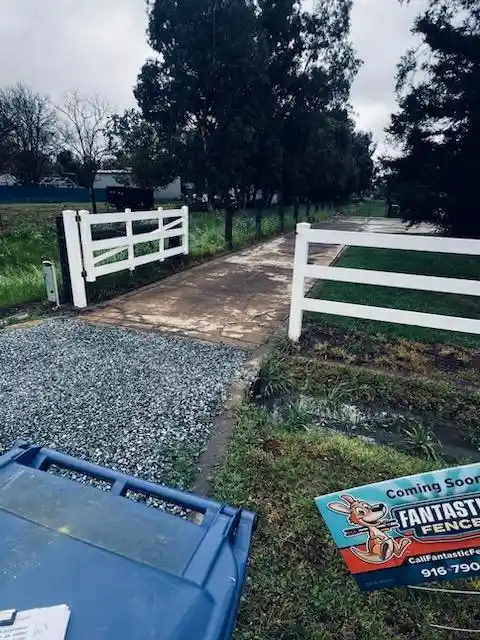
Most horse owners we meet have already been through this once with someone who didn’t return calls, showed up late, or left wire clippings in a pasture where horses were about to be turned out. That experience is exactly why this company exists. Use these questions on anyone you’re considering:
- What horse farm and large-acreage experience do you have?
- What exact fence materials, mesh opening size, and wire gauge are you quoting?
- What’s the post spacing, embedment depth, and corner brace plan?
- What gate widths, and which side of the post are the boards or mesh mounted on?
- Do you call 811 before digging?
- Are you licensed, bonded, and insured, and what’s the license number?
- Is the scope written, and is pricing flat with zero hidden fees?
- Who will actually be on my property, and are they your employees?
- What happens to cleanup when the job is done?
Our answers: CSLB License #979657, licensed, bonded, and insured. Approximately 35 background-checked W-2 employees, not subcontractors. Flat pricing with zero hidden fees, and a written guarantee that the job isn’t finished until you give us the thumbs up. A thorough clean-up after every job, because we understand we’re guests on your property. If you’d like to sketch out numbers before you talk to anyone, our Fence Price Calculator is a no-pressure starting point, and financing is available for Sacramento-region residents.
Frequently Asked Question
What type of fence is best for horses?
A horse-safe woven wire fence with 2-by-4-inch mesh openings and a visible top rail is the most widely recommended all-purpose choice, with a well-built board fence a close second. Woven mesh handles horse containment, and the rail gives a running horse something to see. For corrals and high-pressure pens, steel pipe or horse-rated panels are stronger. Combining two systems is usually safer than relying on one.
What is the most affordable way to fence in horses?
Woven horse mesh with a single sight rail on top generally delivers the most containment per dollar, and properly braced high tensile systems with wider post spacing keep the cost low on long runs by cutting material and labor. Visible electric fencing is affordable as interior cross-fencing, but only inside a permanent perimeter. Weigh lifetime maintenance against up-front cost: a board fence is affordable to build and expensive to keep. Run your layout through our Fence Price Calculator or ask us for a free fence estimate.
What are the different types of horse fences called?
Common fence styles include woven wire fence or no-climb mesh, V-mesh or diamond mesh, board or plank fence, post-and-rail, vinyl or PVC rail, flexible polymer rail, coated horizontal cable, high tensile wire, pipe corral or steel panel fencing, and electric tape or coated wire. Barbed wire and standard cattle field fence also exist on horse properties but are not recommended around horses.
What is the best horse fence for the money?
For most properties, the best equestrian fence per dollar is a 5-foot horse-safe woven wire line with a top sight board, because it balances containment, safety, affordability, and maintenance better than anything else on the list. Properly installed, it holds up under steady pressure, helps prevent injury from hoof entrapment, and doesn’t demand repainting every few years. Spend the savings on solid corner assemblies and properly sized gates, which is where fence failure usually starts.
Build It Once, Build It Right
Safe horse fencing comes from the whole system working together: the right fence materials, enough visibility, correct height, openings a hoof can’t find, solid fence posts and bracing, well-planned gates, careful installation, and honest upkeep. Expensive fences don’t keep horses safe by themselves, and the ideal fence for your property is the one matched to your horses, your ground, and how you actually use it. Picking a material off a list is only the first decision of about ten.
We’ve been building and repairing fences across Sacramento, Placer, El Dorado, Yuba, Yolo, and Nevada counties since 2011, with offices in Rocklin, Sacramento, and Elk Grove (9245 Laguna Springs Dr, Suite #228, Elk Grove, CA 95758, 916-345-0142). If you’re planning a perimeter, dividing a pasture, or replacing a fence line that’s had enough, get a free fence estimate. Call us or book online, and we’ll come walk the property with you.