Key Takeaway
Temporary fencing for construction sites, events, and pools typically means free-standing or driven-post chain link panels that deploy quickly and come down when the job is done. California law requires a permanent pool barrier at least 60 inches tall with self-closing, self-latching gates, so a rented construction fence will never pass inspection. For projects lasting beyond two to four years, a permanent fence is almost always the better value.
Temporary fencing is fast, affordable, and the right answer for most jobs that last less than two to four years: construction sites, remodels, outdoor events, dust screening, and pool excavations. A temporary fence goes up quickly, keeps the public out of hazardous areas, and comes down when the project is done. There’s one exception worth flagging up front. A rented construction fence is not a finished California pool barrier, and it won’t pass inspection. Fantastic Fence doesn’t rent temporary fencing. We’ve installed permanent fencing across the Sacramento region since 2011, so treat this as a straight guide, with contractors, homeowners, event organizers, and pool builders all covered. Sometimes the honest answer is rent.
Temporary Fencing at a Glance

Here’s the quick version of what temporary fencing solutions fit which project.
| Use case | Typical choice | Duration that makes sense |
|---|---|---|
| Commercial construction site | Driven-post temporary chain link | Length of the build |
| Residential remodel | Free-standing fence panels | Weeks to months |
| Events and crowd control | Barricades or panels | Days |
| Dust and visual screening | Windscreen on chain link | Length of the build |
| Pool excavation during construction | Panels or driven-post chain link | Until the permanent barrier passes inspection |
| Finished pool barrier | None, temporary fence never qualifies | Never |
| Long-term perimeter or security | Permanent fence | 2 to 4 years and beyond |
The Four Main Temporary Fence Panels and Barriers
Free-standing chain link panels
These temporary fence panels sit on skid feet or stands with nothing in the ground. They’re the fastest to set and reconfigure, and they work on concrete or asphalt where you can’t dig. The trade-off is stability. They can be pushed over, slid aside, or lifted, and wind is a real factor unless you brace or sandbag them. For a short residential project or a site with a shifting layout, chain link panels like these are hard to beat. Because they’re easy to move and store between jobs, they’re a practical choice for short term fencing.
Driven-post temporary chain link
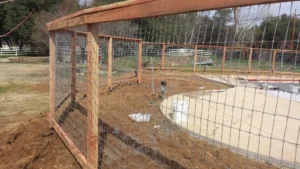
Posts go into the ground with fabric hung on them. That makes the line far more stable and harder to defeat, while still being removable at the end. This temporary fencing solution needs ground you can drive into and utilities located first. ASTM F3342 describes these enclosures at 6 or 8 feet, the common construction heights, and gives you a sturdy, secure barrier for the length of a build.
Welded wire mesh panels
A solid middle option. Welded wire gives you moderate security at a competitive price and a stronger visual barrier than open chain link, which site supervisors often prefer. Welded wire also holds its shape better than loose fabric, so a durable welded wire panel keeps a cleaner line across a busy site.
Barricades and crowd control
These temporary barriers direct people rather than secure property. They’re lightweight, ideal for queue lines and pedestrian flow, and they won’t stop anyone determined. Some come with plastic bases or reinforced feet for stability on hard surfaces.
Construction Fence for Active Job Sites
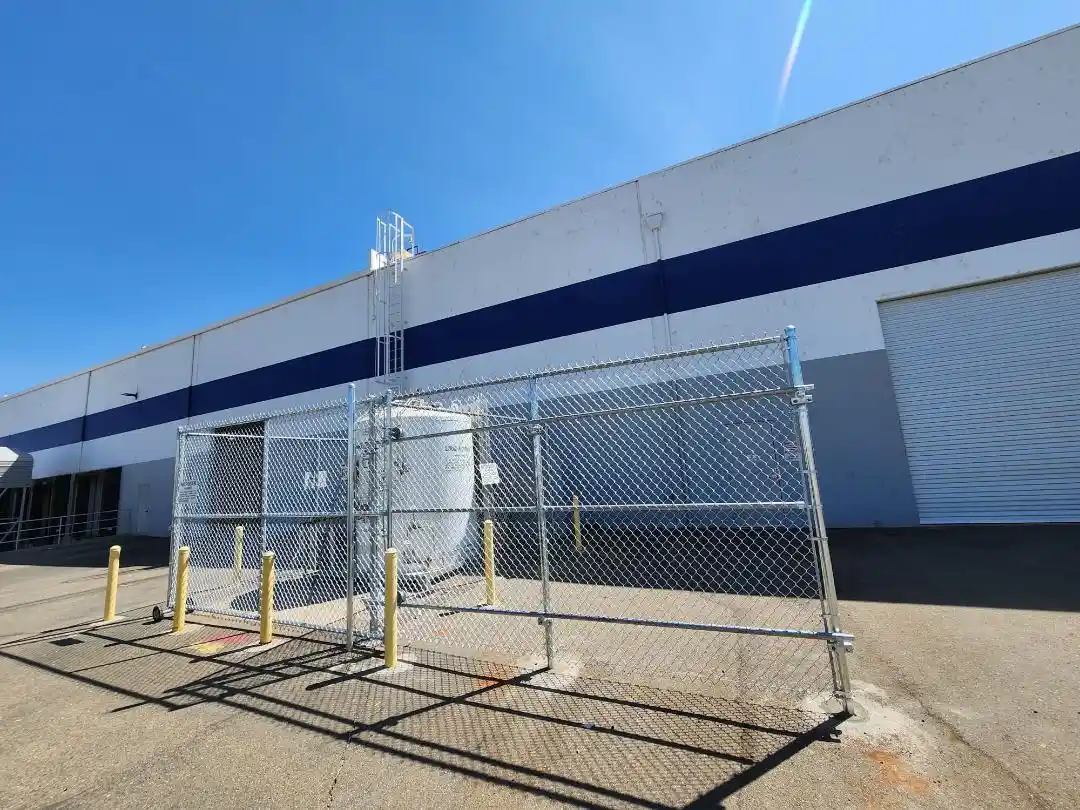
A construction fence does a few real jobs at once on active job sites: it separates the public from work, secures the site, contains equipment and materials, and helps protect the project from theft. Free-standing panels suit short jobs and layouts that keep changing. Driven-post chain link is the better call for the length of a build or an exposed lot, and it’s the type most construction companies choose for secure fencing that lasts the whole schedule. OSHA and site-safety practice call for a secure perimeter, and a 6-foot fence is the common standard, since a continuous, defined boundary reduces liability. This is an easy way to keep foot traffic out and the public safe without a large capital outlay. Barbed wire is generally not used on public-facing residential jobs, though it appears on some restricted industrial sites.
Plan your gates and access points early. Keep the fence clear of fire hydrants, fire department connections, and utility access, which California Building Code Chapter 33 requires during construction. Confirm any permits your city or county expects before work begins, and think about where parking and material deliveries will land. On a large construction site, professional installation usually runs one to three days, and a good crew gets it installed quickly.
Do I Need to Call 811 Before Installing Temporary Fence Posts?
Yes. Any driven post is ground disturbance. In California, you must notify the regional notification center (Underground Service Alert, dialed as 811) at least two working days and not more than 14 calendar days before you dig, except in an emergency (Gov. Code §4216.2, confirmed by the CSLB). Free-standing fence panels on feet usually avoid this, but stakes and anchors can still trigger it. Good contractors never skip the call before any post installation.
Temporary Fence for Events and Crowd Control

The distinction most guides miss is directing people versus securing property. Barricades handle queue lines, entry and exit separation, and pedestrian flow at outdoor events, sporting events, and other public gatherings. Panels are what you want when the event needs a real perimeter: backstage separation, equipment protection, or restricted and hazardous areas. Temporary fence is also how organizers manage crowds during lane closures and staged pedestrian routes.
Fast deployment matters, and so do clear emergency exits and a sensible site layout. Choose your temporary fencing by risk to meet safety needs on your next project. The wrong barrier can create a worse hazard than the one it’s meant to control, especially where crowds press against a line that wasn’t built for it.
Windscreen, Privacy Screens, and Wind Load
Windscreen and privacy screens are an add-on, not a fence type. They control dust and screen the site, blocking roughly 70% to 95% of visibility. They also dramatically increase wind load. A fence that stood fine bare can go down once it’s screened. ASTM warns that the standard temporary fence isn’t built for 110 mph gusts once screening is added. Screened lines need bracing, ballast, or driven-post support. In Sacramento-area wind and storms, that’s a real consideration, not a detail. Privacy screens make sense when you want to keep a project out of public view, but plan the extra load into how the fence is installed.
Temporary Fence for Pools: The Rule People Get Wrong

Fencing a pool excavation during construction is normal and correct. Treating that rented construction fence as your finished barrier is not, and it won’t pass inspection. Here’s the California law in plain English. Health & Safety Code §115922 requires at least two of seven approved drowning-prevention features on a permitted new or remodeled pool. Section §115923 sets the enclosure basics: minimum 60-inch height, maximum 2-inch bottom clearance, no gap that passes a 4-inch sphere, and self-closing, self-latching gates opening away from the pool with the latch no lower than 60 inches.
Local rules add detail. Sacramento County requires chain link pool barriers at least 11 gauge with mesh no greater than 1¾ inches. Standard chain link runs 2 to 2¼ inch, so a compliant fence needs a tighter custom weave, or slats fastened top and bottom to reduce the openings. Placer County matches the 1¾-inch limit, and the City of Rocklin requires a five-foot fence with self-latching gates. A rented fence, however carefully installed, is removable, and that alone disqualifies it. A permanent barrier around the house is what protects a family for the long term. Check Fantastic Fence’s Fence Ordinance Quick Links to confirm current local rules rather than relying on this page.
Fence Rental vs. Building: How to Decide
The practical rule of thumb: if you’ll need the fence for long term use beyond two to four years, a permanent fence usually wins, and the break-even sits somewhere in that window. A fence rental bundles delivery, setup, removal, and repairs with no capital outlay, and on an active site a permanent fence often isn’t possible anyway.
For rental pricing, get local quotes and ask about three-, six-, or twelve-month term pricing, which runs below spot rates. That can save real money on longer construction projects. For a permanent, long lasting option, use Fantastic Fence’s Fence Price Calculator. Build instead when it’s a permanent property perimeter, you want real security, appearance matters, or it’s a pool barrier.
Related Services: When a Permanent Fence Is the Better Answer

When a temporary need turns long-term, these are the permanent options our team installs, each one constructed to last: a good neighbor fence for shared privacy in wood, low-maintenance vinyl, an affordable chain link perimeter to protect the property line, timeless ornamental iron, high-security Durabond steel, Bolt-Up Hidden Steel Posts for a clean seamless look, a code-compliant pool safety fence, and automated gate systems with gate openers. We know Rocklin, Placer, and Sacramento County code, and every installation is built to get it right the first time: licensed, bonded, and insured, CSLB License #979657, background-checked W-2 employees, flat pricing with zero hidden fees, and a written guarantee that keeps you covered.
Does OSHA require fencing around construction sites?
In practice, yes. OSHA and site-safety rules call for a secure perimeter around construction sites, and a 6-foot fence is the common standard to keep the public out of hazardous areas and reduce liability.
Can I use temporary fencing around a pool?
Yes during construction, to fence the excavation. No as your finished barrier. Rented fence panels are the wrong mesh and, more importantly, removable, so they won’t pass California inspection.
What is the cheapest way to make a temporary fence?
Free-standing chain link panels on skid feet are typically the most affordable temporary fencing solution and the fastest to set and reconfigure. Sandbag or brace them against wind, and confirm they meet your site’s security needs.
Is it cheaper to rent temporary fencing or install a permanent fence?
Rent for weeks or months. If you’ll need it beyond two to four years, or it must pass pool-barrier inspection, a permanent fence is the better value. Get local fence rental quotes for the short term, and a free estimate for the permanent option.
If your temporary need is turning into a permanent fence, a pool safety fence, or a long-term security perimeter, let’s talk. Contact our team, get a free fence estimate, and we’ll help you build it right.